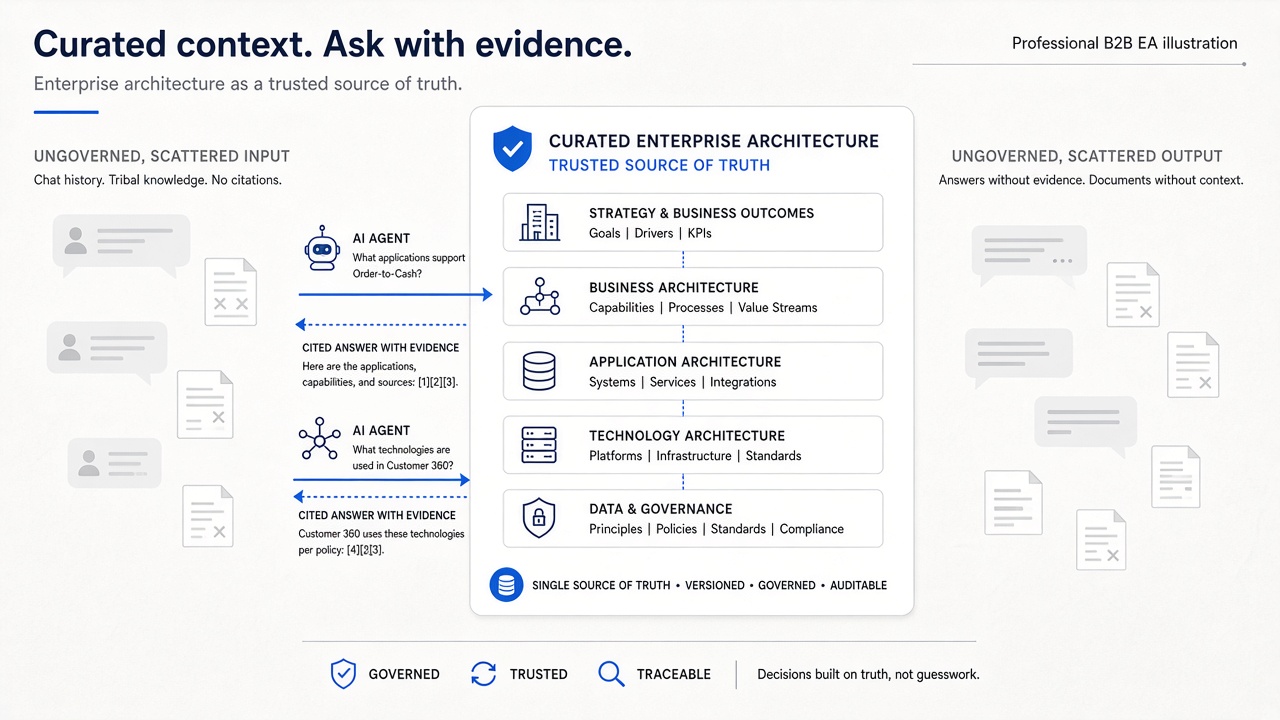
What changes when everyone can ask an AI?
Blast-radius and “how does this integrate?” questions no longer wait only for Dave — they go to ChatGPT, Copilot, or an internal bot. If each team asks a different document pile, you get confident, divergent answers. The agentic era does not remove the need for enterprise architecture; it raises the cost of not owning shared context.
People ask: who owns enterprise context for AI, why isn’t Copilot enough for architecture decisions, how do we govern AI answers about our landscape.
Why can’t every team just use Copilot on their docs?
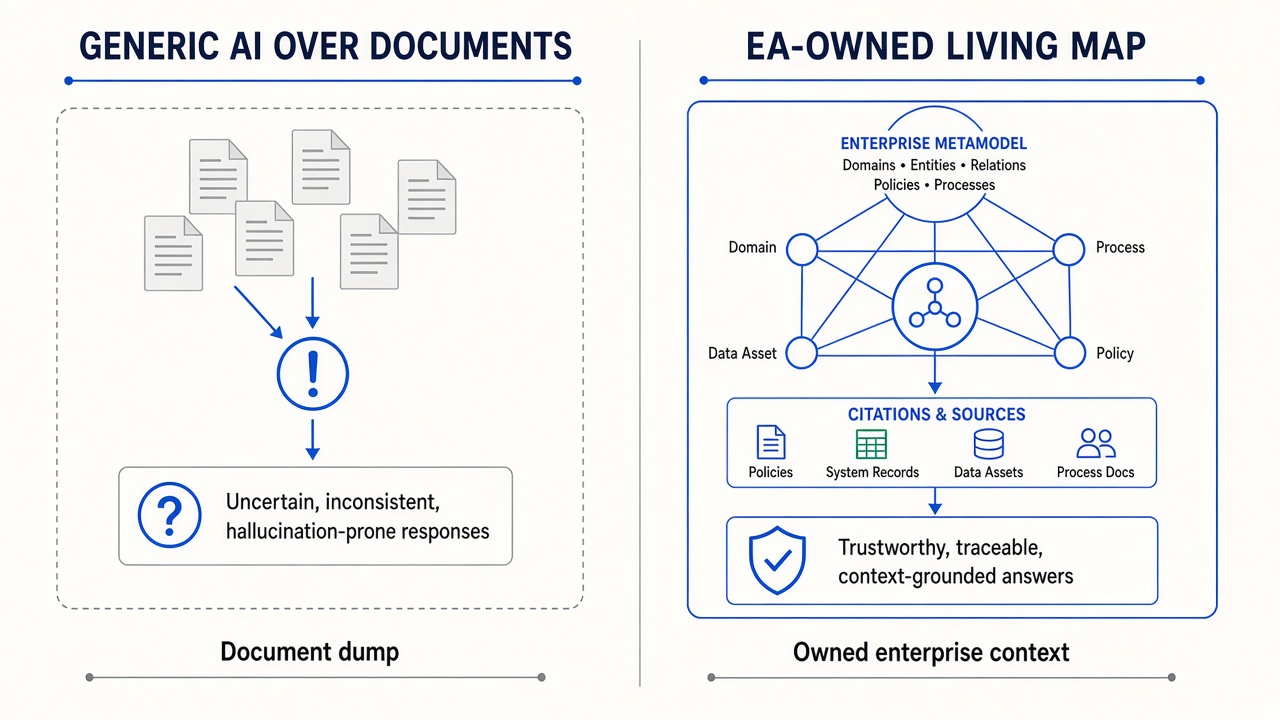
Document RAG retrieves passages; it does not maintain a curated metamodel, resolve conflicts, or know what was rejected last year. Without owned context, agents invent, mix stale sources, and skip constraints. That is why Copilot or plain RAG alone is not enough for EA.
What does “EA owns enterprise context” mean?
EA governs the living map of entities, relationships, and evidence that humans and agents use for architecture decisions — with curation and citations, not only chat history. Tribal memory (“let me check with Dave”) does not scale to agent speed.
What happens if EA does not own it?
- Every squad’s bot becomes a competing architecture authority.
- Governance cannot audit why a decision was recommended.
- Delivery outruns memory — the continuum break in beyond traditional EA gets worse, not better.
How does DecisionPen solve this?
DecisionPen is how EA owns enterprise context for humans and agents — without pretending Confluence-plus-Copilot is governance.
- Owned living map — metamodel entities and relationships are the shared authority, curated by people who can be held accountable.
- Evidence-bound answers — Enterprise Ask grounds responses in the map and linked sources so claims are auditable.
- Not plain RAG — structure + curation beats token similarity over a document dump (why not Copilot alone).
- Continuum-ready — the same context serves strategy, SAs, and generated artefacts so every squad’s bot is not a competing architecture office.
Put one contested landscape question into a DecisionPen trial and compare the cited answer to an ungrounded chatbot — that is the ownership test.
When is DecisionPen not the right tool?
If you need a primary diagramming canvas (Visio, Lucid, BPMN). DecisionPen owns living context and map-grounded Ask — not freeform drawing.