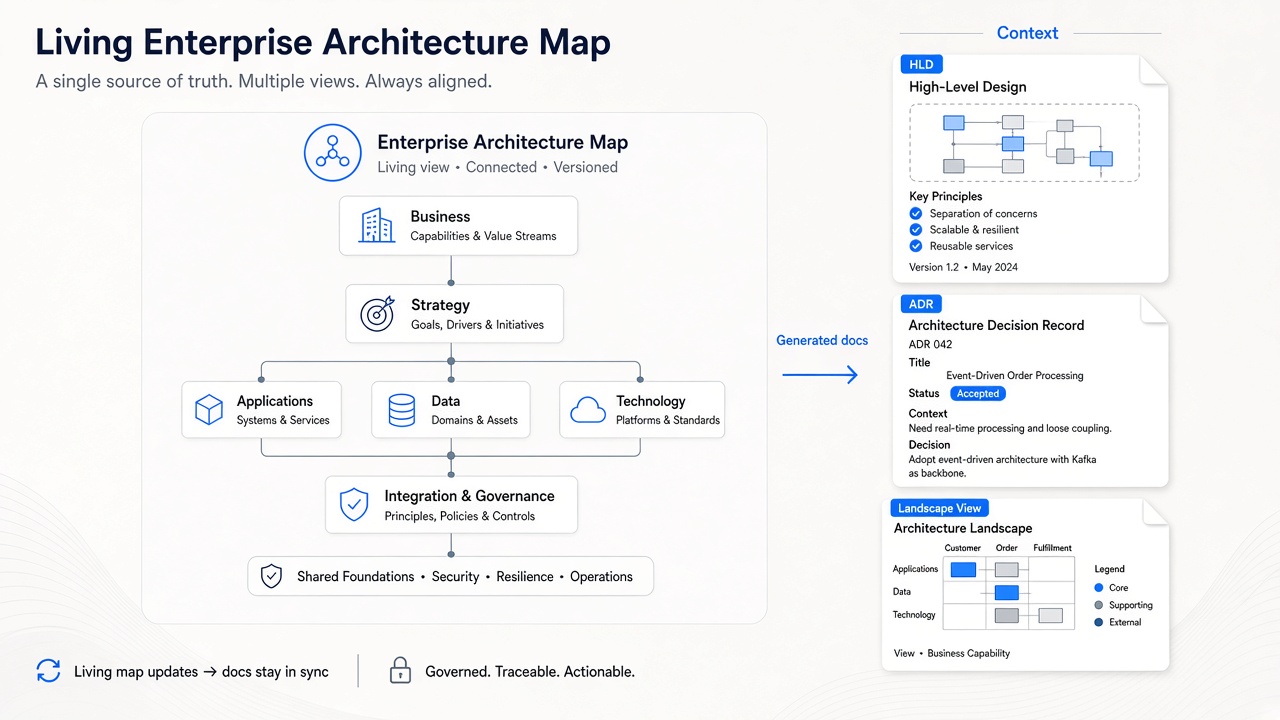
Why do architecture documents keep restating the landscape?
Most of an HLD repeats facts the enterprise should already know: systems in scope, interfaces, ownership, technology choices, constraints. When those facts live only in the document, every project rewrites them — and institutional memory never compounds. People search for: generate HLD from architecture repository, stop rewriting the landscape in every design pack.
What does “documents as views” mean?
The curated map holds shared truth. An HLD, ADR, interface catalogue, or migration pack is a formatted view over that context — reviewed by an architect — not a parallel private system of record. That is the SA promise of an Architecture Decision Workspace.
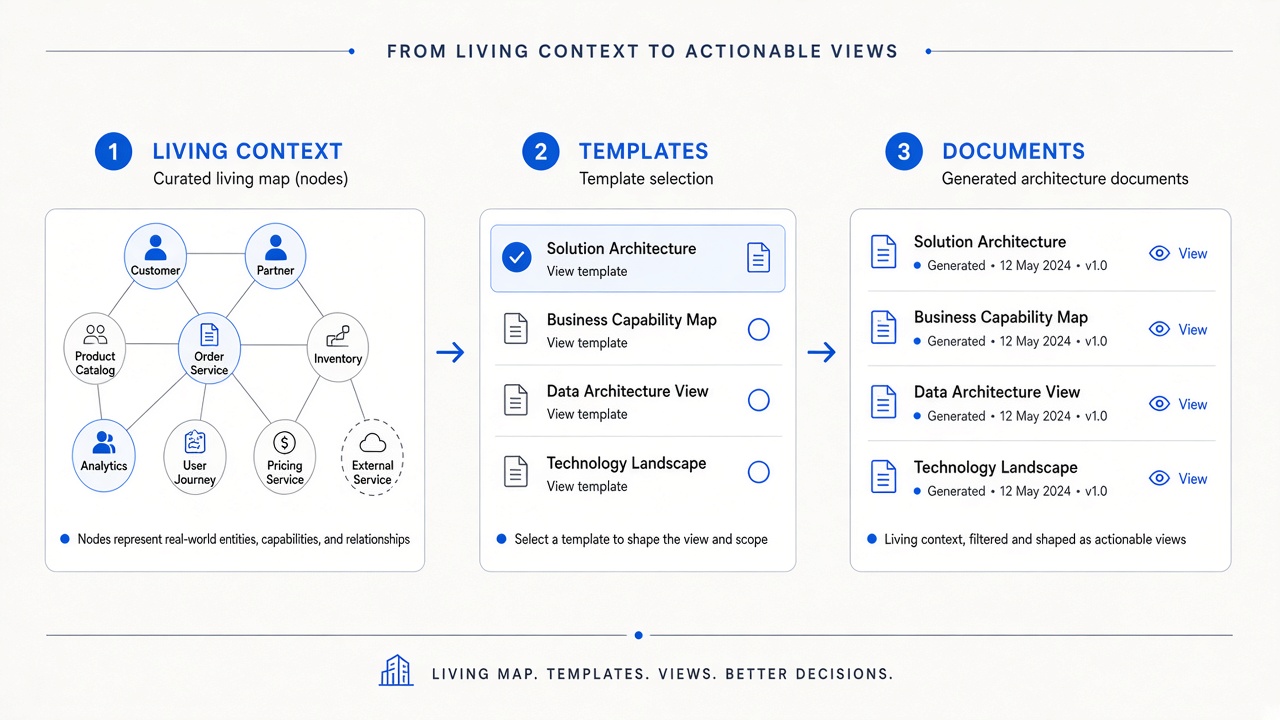
How does generation from living context work?
- Curate the slice — applications, capabilities, integrations, and evidence for the programme (incremental modelling).
- Apply a template — your organisation’s structure and vocabulary, not a generic essay.
- Generate the draft view — landscape sections filled from the map; judgement sections left for humans.
- Review and contribute back — accepted design updates re-enter the living model so the next team inherits them.
What breaks if documents stay the only truth?
You get the rediscovery loop described in why solution architects rediscover the landscape: HLDs die in SharePoint; EA never updates; the next programme starts from zero.
How does DecisionPen solve this?
DecisionPen implements documents-as-views end to end — not as a slide about the future of EA.
- Curated workspace context — the map holds entities, relationships, and evidence SAs would otherwise retype into an HLD.
- Artefact templates — supply your organisation’s HLD, ADR, interface, or migration templates; DecisionPen populates landscape sections from the workspace (SA workflow).
- Human review on judgement — trade-offs, risks, and novel design stay with the architect; generation handles restatement.
- Loop closed — accepted design updates return to the living map so the next document starts richer than the last.
- Diagram images from context — views of the map, not a substitute for Visio when freeform drawing is the job.
Start a trial with one template and one system of interest — prove a draft artefact from curated context in days.
When is DecisionPen not the right tool?
If freeform diagramming or BPMN drawing is the primary job, use Visio or Lucidchart. DecisionPen generates documents and diagram images from curated context; it is not a drawing canvas.