Product

The Architecture Decision Workspace that starts from what you already have

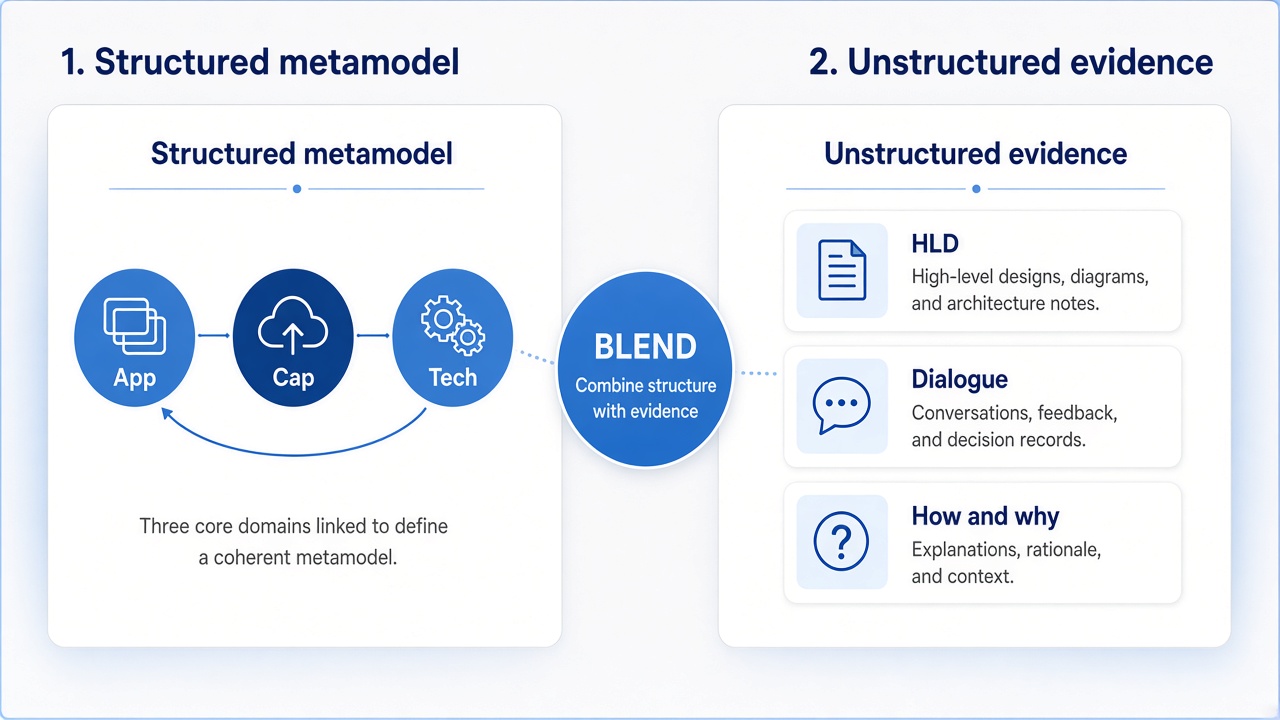
DecisionPen blends structured enterprise architecture entities with the documents, decisions and expert knowledge that explain them. It is not a chatbot bolted onto a wiki, and it is not another empty EA repository waiting for months of manual factsheet entry.

Start structured-first, document-first or with a blank domain · No credit card required

No blank repository

Start from the knowledge you already trust

Skeptical of building architecture only from unstructured text? So are we. DecisionPen offers governed on-ramps for structured and unstructured knowledge — and most enterprises will use both.

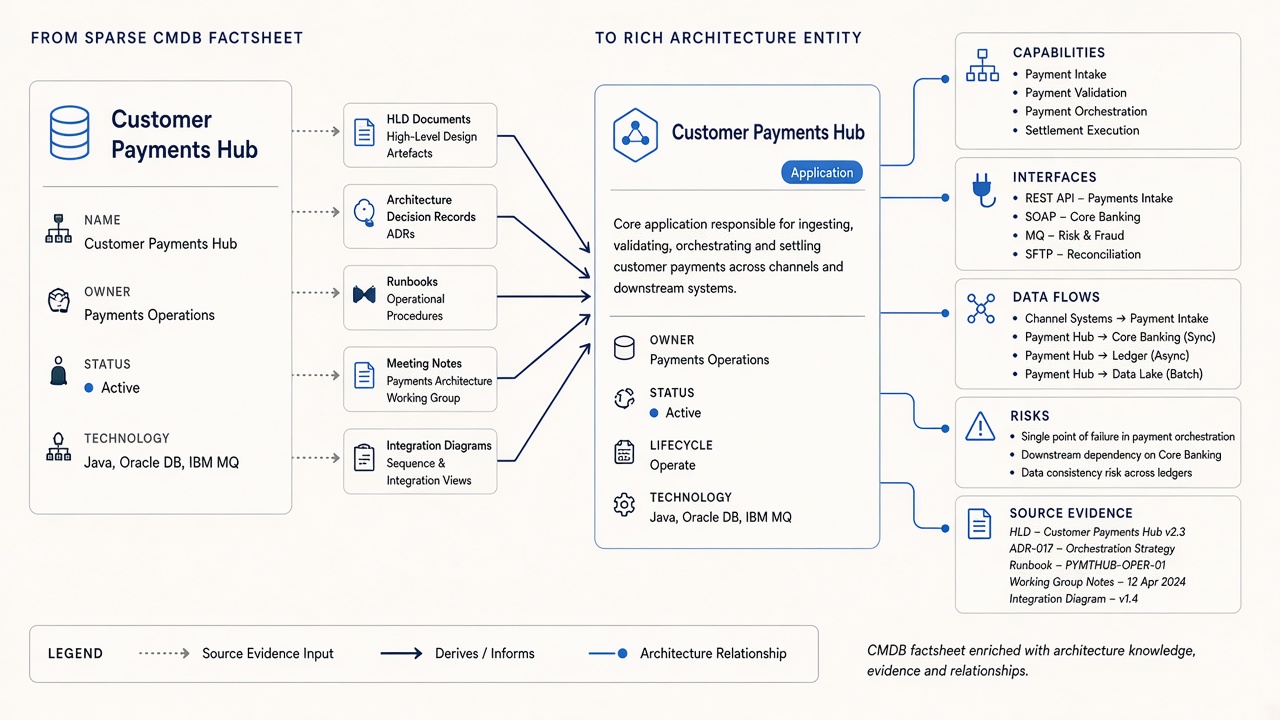
A structured CMDB catalogue being enriched with documents, rationale and evidence

Path 1 · Structured-first

Seed from your CMDB or inventory

Export the catalogue you already maintain and import applications, technology components and similar items from a spreadsheet. Establish trusted identity first — then enrich the thin factsheets around it.

How factsheet enrichment works
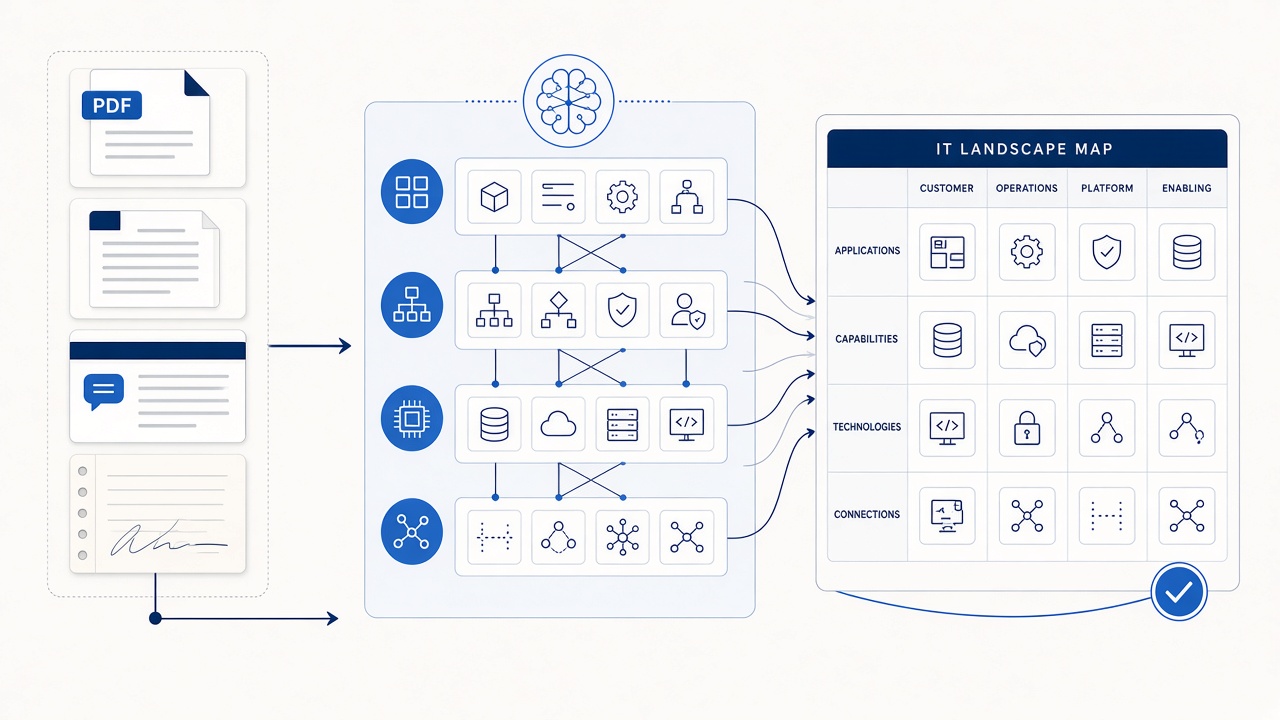
Unstructured documents and transcripts being transformed into a structured IT landscape model

Path 2 · Document-first

Discover from institutional memory

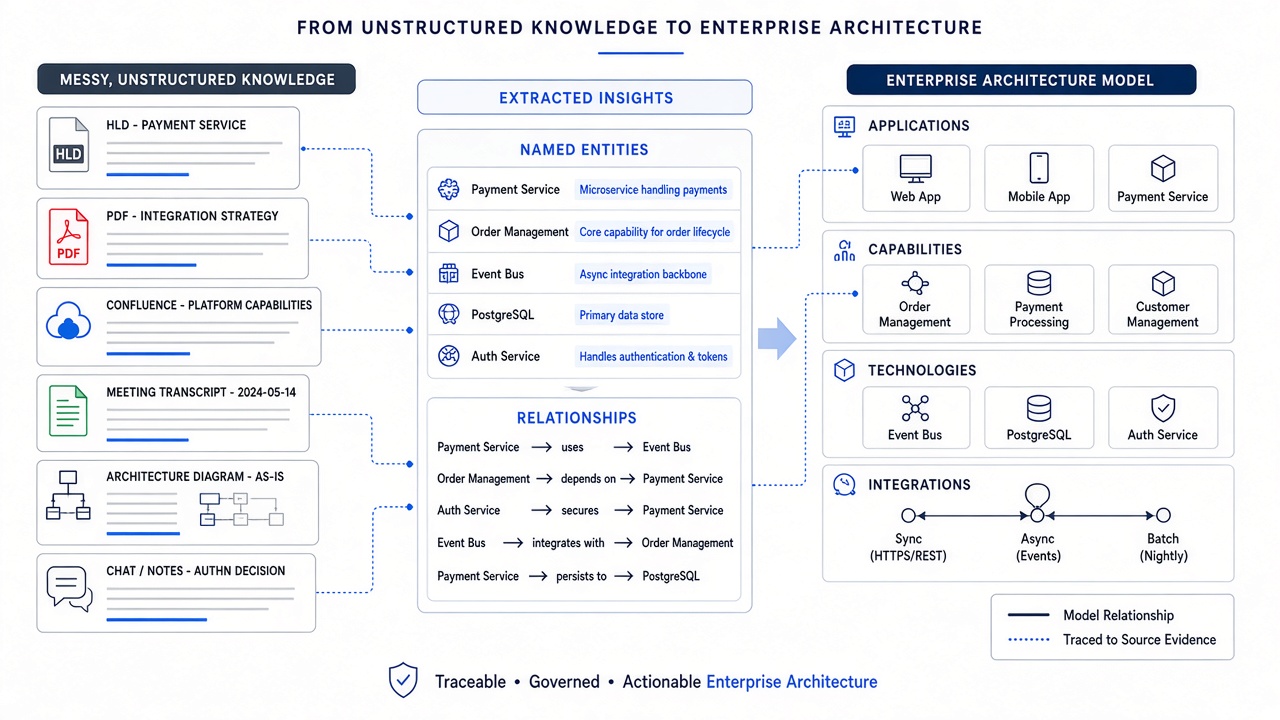
Start with HLDs, PDFs, wiki pages, diagrams, runbooks, meeting transcripts and expert narratives. DecisionPen proposes entities and relationships; architects curate them into the same living model.

Automated landscape modelling
Unstructured knowledge being resolved into applications, capabilities and relationships in an enterprise architecture model

Path 3 · Natural language

Describe a blank domain

Where no reliable inventory or document set exists, describe the domain in plain English. DecisionPen drafts metamodel-aware structure for experts to review, correct and extend.

How incremental modelling works

Both paths converge: structured identity plus How-and-Why evidence, reviewed by humans. A spreadsheet extract from the catalogue you already maintain is enough to seed the model today.

How DecisionPen works

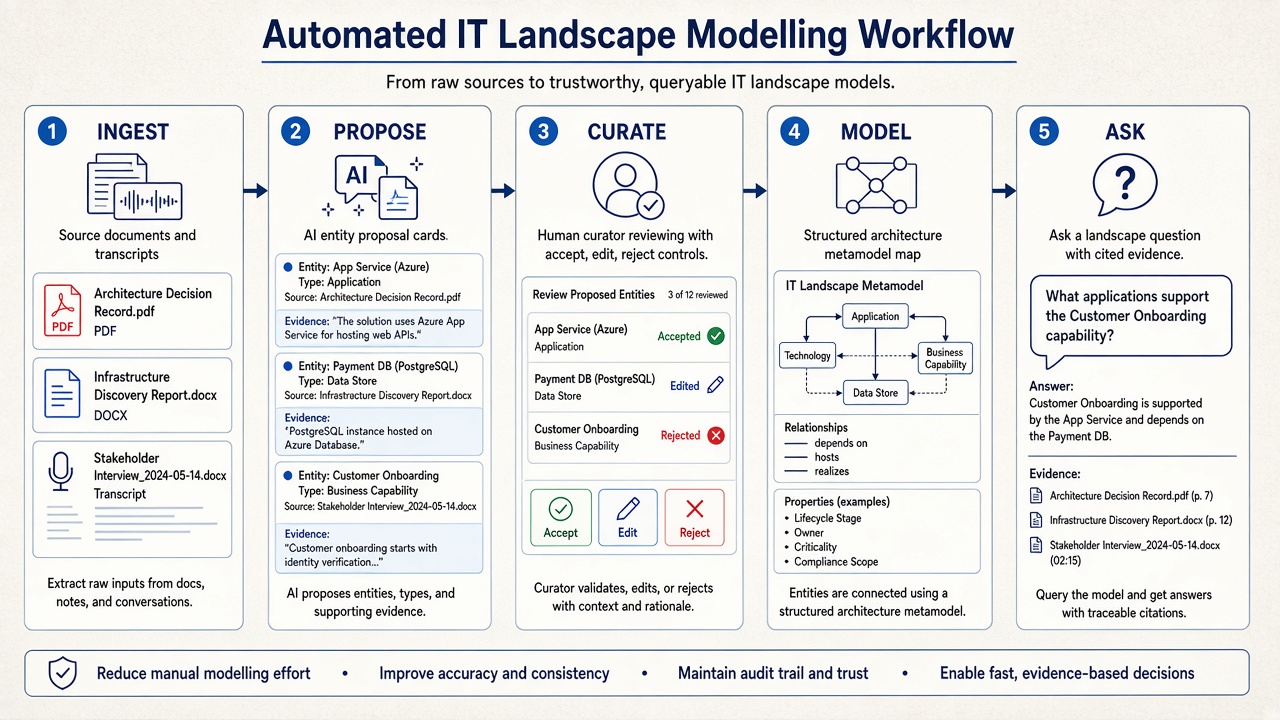
A governed workflow for turning existing knowledge into a living architecture model — not an unsupervised document dump.

  1. 1

    Seed or ingest

    Import a structured catalogue extract, add documents and transcripts, or describe a domain in natural language.

  2. 2

    Propose

    AI interprets the evidence against an EA metamodel and proposes entities, relationships and factsheet enrichment.

  3. 3

    Curate

    Architects accept, edit, reject or defer proposals. Nothing becomes canonical just because an AI suggested it.

  4. 4

    Map & enrich

    Accepted knowledge joins a living landscape of capabilities, applications, technologies, integrations, owners and evidence.

  5. 5

    Ask & generate

    Interrogate the curated map in plain English and generate architecture documents and diagram images from the same context.

Five-stage automated IT landscape modelling workflow: ingest, propose, curate, model and ask
Automated modelling becomes trustworthy when AI proposals pass through evidence binding and human curation before joining the map.

Read the detailed explanation in how automated enterprise architecture modelling works.

What you can do in DecisionPen

One workspace for building the model, keeping it trustworthy and using it to make decisions.

Catalogue import & factsheet enrichment

Start with applications and technology components from a CMDB or inventory spreadsheet, then add purpose, behaviour, integrations, decisions, constraints, risks and evidence.

Automated landscape modelling

Turn HLDs, PDFs, wiki pages, diagrams, transcripts and dialogue into metamodel-aware proposals instead of manually retyping the estate into blank factsheets.

Human-in-the-loop governance

Experts review aliases, duplicates, uncertain relationships and conflicting evidence before changes join the trusted model. AI drafts; people decide.

Living landscape & impact analysis

Explore how capabilities, processes, applications, technologies, integrations and data connect. Trace neighbours, dependencies and blast radius before change ships.

Enterprise Ask with evidence

Ask ownership, dependency, rationale and gap questions in plain English. Answers are grounded in the curated map and linked back to source evidence — not generated from document similarity alone.

Artefacts from living context

Generate solution blueprints, ADRs, architecture documents and diagram images as views of the curated landscape, so documentation becomes a byproduct of truth rather than a separate writing project.

Metamodel rigour — including LeanIX-aligned modelling

DecisionPen understands relationships between business capabilities, applications, processes, technologies, integrations and data. Modelling can align with LeanIX-style structures when that standard matters to your organisation — as proof of architectural rigour, not as the product identity.

Relationship integrity keeps the landscape queryable for portfolio decisions, transformation planning, due diligence, roadmaps and reporting.

Ask the landscape. Generate the artefact.

The value of the model appears when leaders and architects can use it during real decisions — without reopening a round of workshops and expert interviews.

Questions Enterprise Ask can address

  • Which applications support this business capability, and who owns them?
  • What depends on the Customer Payments Hub — and what is the blast radius if it changes?
  • Why was this platform chosen, and which documents support that decision?
  • Which integrations are undocumented, inferred or missing an owner?
  • Which applications have a name and status, but no purpose, rationale or evidence?
  • What would block retiring this system?
How Enterprise Ask works

Outputs from the same curated context

  • Solution blueprints and architecture decision records
  • Architecture documents generated from templates and living context
  • Diagram images generated as views of the model — not maintained as separate drawings
  • Landscape, dependency and rationalisation views for decision-making
Generating docs from living context
Architecture Decision Workspace model connecting structured entities with supporting evidence
The map is more useful when every important entity keeps the How-and-Why evidence behind it.

See the workspace in action

Follow a real system from knowledge capture to a curated map you can interrogate.

Product walkthrough

Follow the Customer Payments Hub path: from knowledge to a curated map you can interrogate.

Ready to try it yourself?

See it live

When DecisionPen fits — and when it does not

Clear boundaries make the product easier to evaluate and the model easier to trust.

Choose DecisionPen when

  • Your CMDB or EA factsheets identify what exists but not why it matters or how it behaves.
  • Architecture knowledge is trapped in documents, diagrams, meetings and a few experts’ heads.
  • Teams repeatedly rediscover the landscape for projects, migrations, due diligence or M&A.
  • You need a living architecture decision model that can be questioned — not a one-off inventory exercise.

Choose another tool when

  • You need an operational CMDB for live infrastructure records, discovery and configuration management.
  • Your primary job is freeform Visio, Lucidchart or BPMN drawing rather than modelling from evidence.
  • You only need generic document search or a chatbot over files, with no governed architecture model.

DecisionPen can start from a spreadsheet extract of your CMDB or inventory for CMDB-seeded modelling.

Product FAQs

What is DecisionPen?
DecisionPen is an Architecture Decision Workspace for enterprise architecture. It combines structured EA entities and metamodel relationships with unstructured How-and-Why evidence from documents, transcripts and expert knowledge, then lets teams curate, interrogate and generate artefacts from that living context.
Can I start DecisionPen from a CMDB?
Yes. You can export a CMDB or application inventory to a spreadsheet and import catalogue items such as applications and technology components as a structured skeleton. You can then enrich those factsheets with purpose, integrations, rationale, constraints and evidence.
Can I start from documents instead of a structured inventory?
Yes. DecisionPen can ingest HLDs, PDFs, wiki pages, diagrams, meeting transcripts and natural-language descriptions. It proposes metamodel-aware entities and relationships for human curation, so you do not have to begin with blank factsheets.
How is DecisionPen different from Copilot or document RAG?
Copilot and plain RAG retrieve or summarise text. DecisionPen resolves evidence into governed EA entities and relationships, keeps provenance visible, requires human curation before knowledge becomes canonical, and answers future questions from that curated model with evidence.
Is DecisionPen a LeanIX replacement or a complement?
It can be either, depending on your operating model. DecisionPen supports LeanIX-aligned metamodel modelling and core EA landscape work, while adding unstructured evidence, natural-language and incremental modelling, Enterprise Ask and artefact generation. Some teams complement an existing EA platform; others switch.
Is DecisionPen a drawing tool or a CMDB replacement?
No. DecisionPen is not a freeform Visio, Lucidchart or BPMN canvas, and it is not an operational CMDB. It generates diagram images and architecture documents from curated context, and it can use a CMDB or inventory extract as a starting skeleton for architecture decisions.
Go deeper

Start with a landscape slice you already understand

Bring a CMDB extract, a small document set or one system of interest — and see the living map form.

See it live

No credit card required