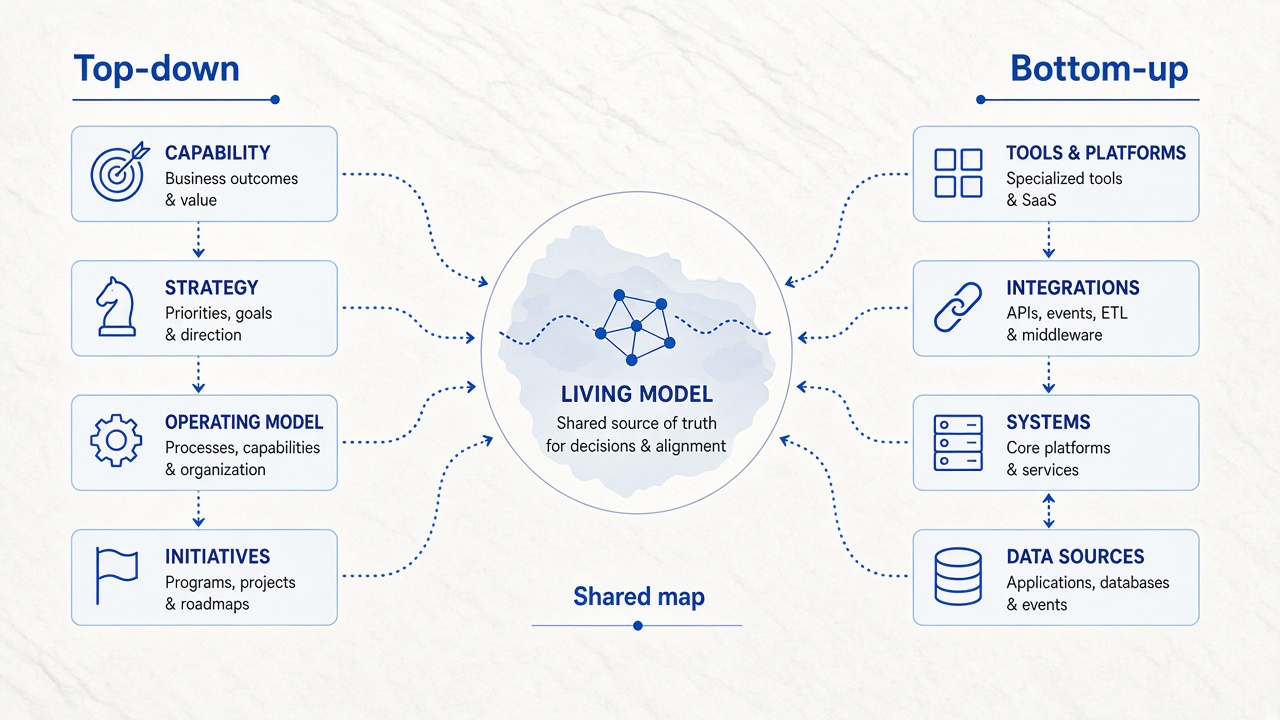
Should enterprise architecture start top-down or bottom-up?
Practitioners ask this constantly — and both camps have scars. Pure top-down promises strategy and capabilities first, then stalls on empty factsheets. Pure bottom-up promises “start from the systems we have,” then drowns in inventories without a frame for decisions. The useful answer is hybrid.
Why does pure top-down EA fail?
It depends on months of manual population, often strips How and Why, and drifts because delivery reality never feeds the model. Architects become clerks; the repository never earns trust. That is the pattern behind why architects hate manual modelling and beyond traditional EA.
Why does pure bottom-up EA fail?
You collect applications, interfaces, and CMDB noise without a shared strategic language. Governance cannot decide; capability conversations restart every quarter; leaders cannot see investment themes.
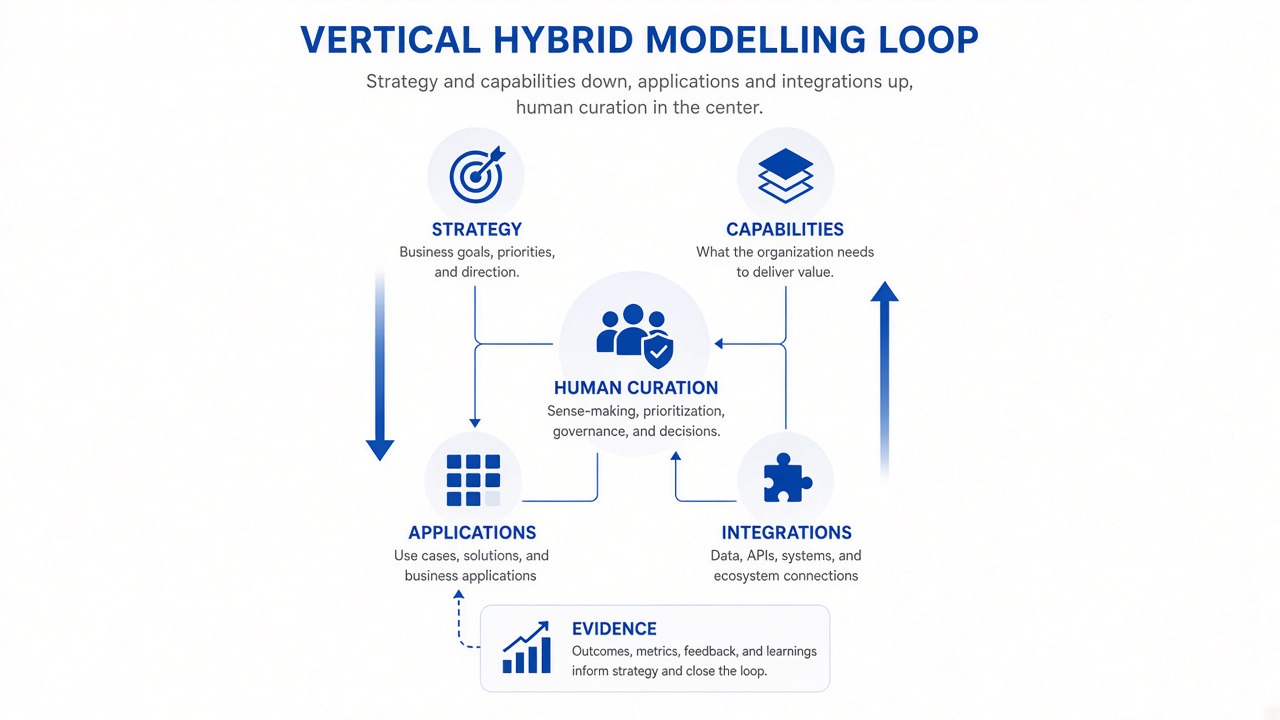
What does hybrid modelling look like in practice?
- Top-down frame — capabilities, principles, standards, and roadmap themes set structure.
- Bottom-up evidence — meetings, transcripts, HLDs, repos, and runtime realities propose entities and links (incremental modelling).
- Human curation — experts accept, reject, and enrich so the map stays trustworthy for Ask and for generated docs.
How does this connect to capability maps?
Capabilities are the classic top-down artefact. They only stay honest if living application and delivery facts refine them — see how capability maps evolve from living facts.
How does DecisionPen solve this?
DecisionPen is built for hybrid modelling in one workspace — not choosing camps.
- Top-down frame — model capabilities, standards, and roadmap themes in a metamodel (LeanIX-aligned structures available where that is your language).
- Bottom-up intake — incremental modelling proposes applications, integrations, and links from documents, meetings, transcripts, and natural-language descriptions.
- Curation as the join — humans accept or reject proposals so strategy and evidence meet in one trusted map.
- Same map for Ask and docs — Enterprise Ask and generated artefacts consume the hybrid result, so neither direction is theatre.
Trial a capability-led slice and a document-fed bottom-up pass on the same domain — see the join work.
When is DecisionPen not the right tool?
When freeform diagramming or BPMN drawing is the primary job. DecisionPen supports hybrid living modelling and generated views — not Visio-style canvases.