Why this question matters for the future of EA
Many teams now ask: can’t we just use Copilot, ChatGPT, or a RAG chatbot over Confluence? For writing assistance, yes. For trustworthy answers about the enterprise landscape — applications, capabilities, integrations, ownership, blast radius — plain generative AI hits structural limits. Understanding those limits is how you see why DecisionPen exists.
What Copilot and general GenAI are good at
Coding copilots and general LLMs excel at local synthesis: drafting an HLD section, summarising a meeting, rewriting a paragraph, suggesting patterns from public knowledge. They accelerate document production. They do not, by themselves, maintain a governed model of your enterprise.
What plain RAG actually does
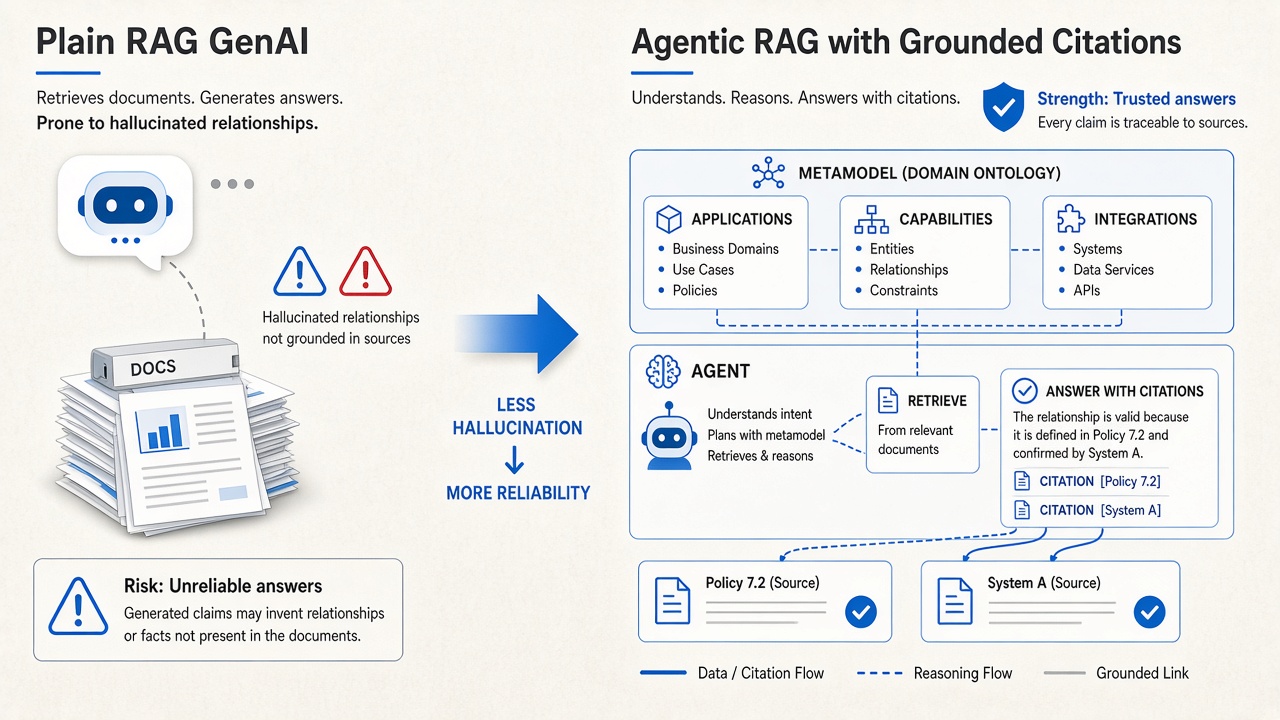
Retrieval-Augmented Generation (RAG) finds text chunks that look similar to a question, then asks a language model to answer from those chunks. That helps when the answer is a paragraph waiting to be found. Enterprise architecture questions are often different: they require composing a structured picture across many sources, enforcing valid relationships, and knowing what is canonical versus stale.
- Chunk ≠ entity. “Customer Payments Hub” may appear under five names across HLDs; RAG does not unify them into one application entity unless you build that layer.
- Similarity ≠ dependency. Two systems mentioned near each other are not the same as a modelled integration with direction, protocol, and criticality.
- Fluency ≠ truth. LLMs fill gaps confidently. In EA, a wrong edge can mis-rank risk for a migration or retirement.
- No curation loop. RAG re-reads documents; it does not create a living map experts improve over time.
Why metamodel awareness changes the answers
A metamodel-aware agent — the DecisionPen approach — treats architecture as a constrained knowledge system:
- Typed entities — applications, capabilities, technologies, integrations, initiatives, and related types.
- Valid relationships — proposals must make architectural sense, not merely linguistic sense.
- Evidence binding — unstructured context (how and why) stays attached instead of being discarded after a summary.
- Human curation — experts confirm what becomes institutional memory.
- Map-grounded Ask — questions traverse the curated model and cite evidence, rather than only remixing retrieved prose.
That is why answers about landscape impact, inheritance of enterprise context for solution architects, and incremental modelling cannot be efficiently matched by a generic copilot bolted onto a document store. For the broader framing, see the Architecture Decision Workspace and Enterprise Ask articles.
| Criterion | Copilot / plain RAG | Metamodel-aware EA agent (DecisionPen) |
|---|---|---|
| Knowledge unit | Text chunks and embeddings from documents or chat history. | Metamodel entities, relationships, and bound evidence passages. |
| Architectural constraints | None — the model invents plausible structure freely. | Entity types and relationships must fit the EA metamodel. |
| Blast radius / dependency reasoning | Guessed from nearby prose; easy to miss critical links. | Traverses curated relationship graph, then cites evidence. |
| Update model | Re-index documents; no governed landscape state. | Incremental propose → curate → map loop with human control. |
| Accountability | Hard to know what is institutional truth vs fluent fiction. | Canonical map plus citations; unknowns can remain explicit. |
| Fit for EA decisions | Useful for drafting prose; weak as a system of decision record. | Built as an Architecture Decision Workspace for the continuum. |
When GenAI alone creates false confidence
Common failure modes teams discover too late:
- Invented topology — the model “completes” missing integrations that were never validated.
- Stale authority — an old HLD ranks high in retrieval while the landscape has moved on.
- No shared memory — each chat starts over; EA and SA still do not inherit one continuum.
- Governance gap — nobody can point to the curated system of record behind the answer.
How this justifies DecisionPen
DecisionPen is not “ChatGPT for architects.” It is an Architecture Decision Workspace: metamodel-aware ingestion, incremental curation, preserved unstructured context, and Ask grounded in that blend. Plain RAG cannot efficiently replace that stack because the hard problem is not retrieving paragraphs — it is maintaining decision-ready enterprise knowledge across the IT Knowledge Continuum.