Why we use the phrase Architecture Decision Workspace
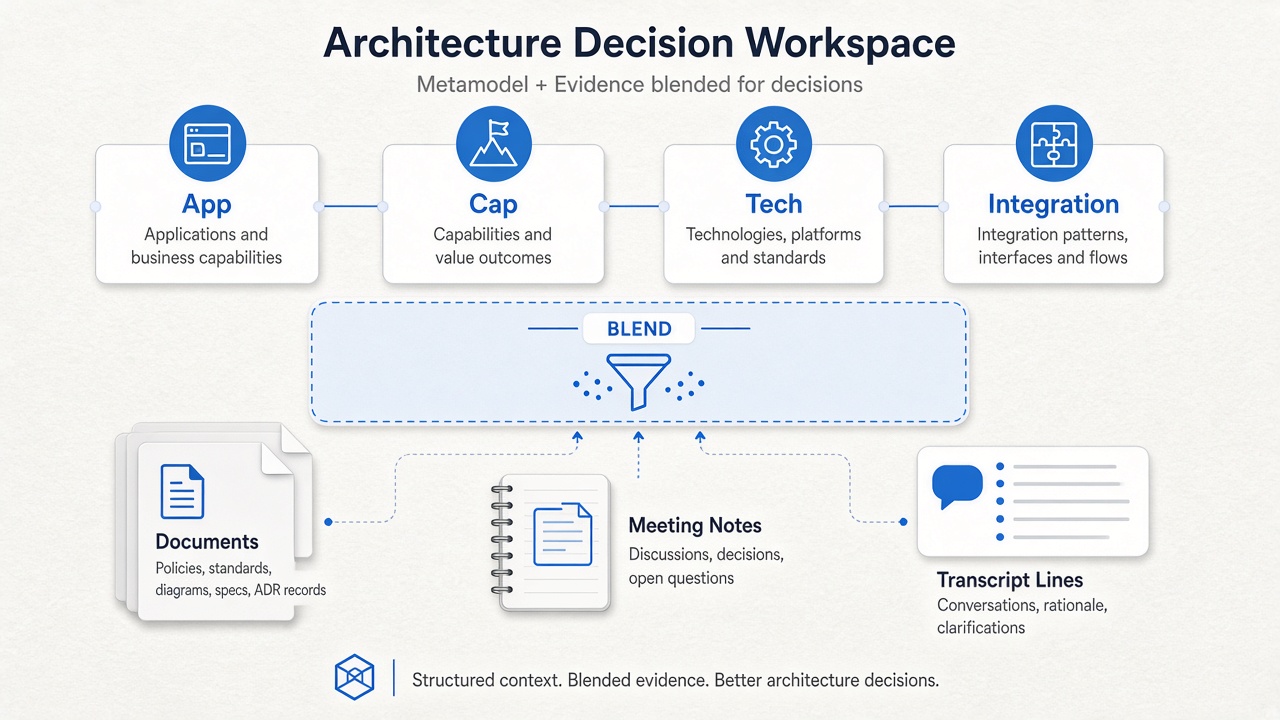
DecisionPen includes the enterprise architecture modelling capabilities organisations already expect — landscape entities and relationships, LeanIX metamodel support, roadmaps, and reporting — and then goes further. What most EA suites underweight is a place to harmonise IT knowledge context: structured entities and the unstructured how-and-why evidence, plus modelling in natural language, so decisions across the continuum stay grounded.
We call that place an Architecture Decision Workspace (ADW). A workspace, not a filing cabinet: people come here to model, curate, interrogate, and decide — with institutional memory close at hand. It can complement LeanIX when coexistence is required, or become the primary EA modelling system when teams want metamodel compatibility without leaving context behind.
What traditional EA chooses to keep — and discard
Historically, enterprise architecture tools shaped context for strategic decisions: capability maps, application portfolios, technology standards, roadmap views. That framing is legitimate. It is also incomplete for the continuum.
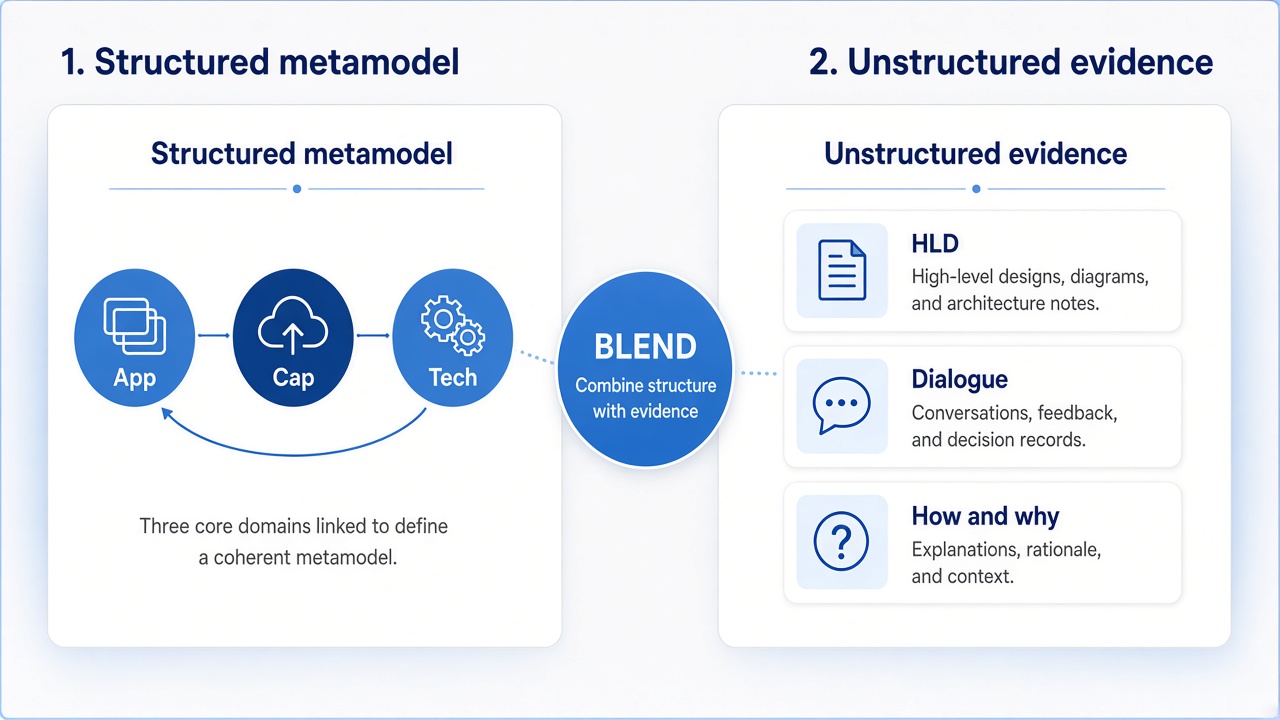
Classic EA models typically store entities and relationships at a level that supports portfolio questions. They are rarely designed to retain the internal how and why of an entity — the design rationale, integration subtleties, interview nuance, or document passages that explain why this application exists in this shape. Those details are treated as out-of-scope documentation living elsewhere.
Elsewhere is where institutional memory goes to die: outdated HLDs, abandoned Confluence spaces, and the heads of a few senior people who are always in meetings.
What DecisionPen refuses to lose
DecisionPen keeps the metamodel — applications, capabilities, technology, integrations, initiatives, and the relationships among them — because structure is what makes knowledge queryable and comparable.
Equally, it indexes and links the unstructured context that evidences those entities: documents, transcripts, meeting notes, repository signals, and narrative from subject-matter experts. The map is not a hollow inventory; it is a curated synthesis grounded in citations.
- Structured layer — full EA modelling with metamodel-aware entities and relationships, including LeanIX metamodel support.
- Evidence layer — the passages and dialogue that justify and explain those entities.
- Decision loop — propose → curate → map → ask → produce artefacts, with humans in control.
Who the workspace is for
Because the continuum spans roles, the ADW is not an architect-only drawing board. It serves anyone who must decide under change pressure: enterprise and solution architects, CTOs and CIOs, engineering leads, programme leaders, and partners running discovery-heavy transformations.
The next articles contrast this with traditional EA scope, then show how incremental modelling and solution-architect workflows make the continuum practical rather than aspirational.