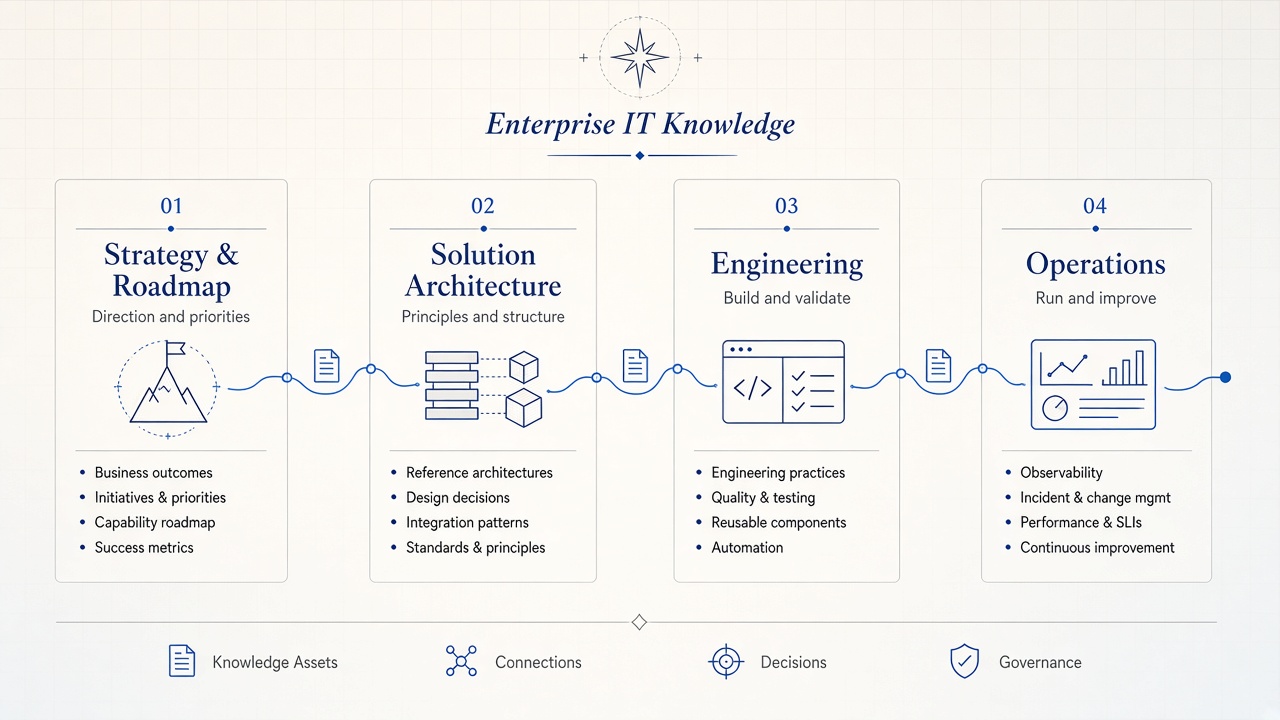
What we mean by a continuum
Every enterprise runs on a chain of technology decisions. Those decisions do not live in a single role or a single tool. They span four regimes that together form what we call the IT Knowledge Continuum:
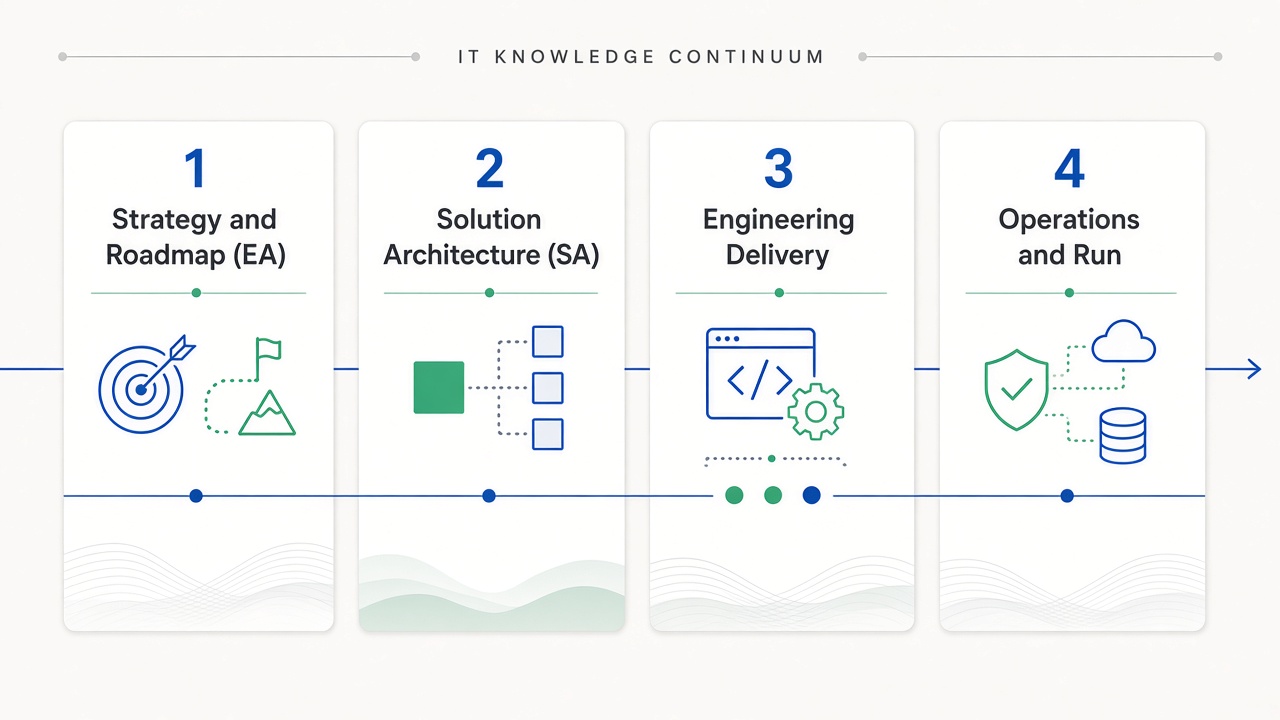
- Strategy & roadmap (enterprise architecture) — capabilities, portfolio direction, standards, investment sequencing, and the structural map of the landscape.
- Solution architecture — project-level designs, HLDs, integration choices, and the how/why behind a delivery slice of the enterprise.
- Engineering — repositories, services, APIs, pipelines, and the implementation truth that either honours or quietly revises design intent.
- Operations — runtime ownership, incidents, change impact, and the lived behaviour of systems once they leave the design room.
Why the continuum is broken today
In most organisations, each quadrant has competent tools and talented people. What is missing is the connective tissue. Strategy repositories, design documents, codebases, and operational systems of record optimise for local work. They rarely preserve a shared, decision-ready memory across handoffs.
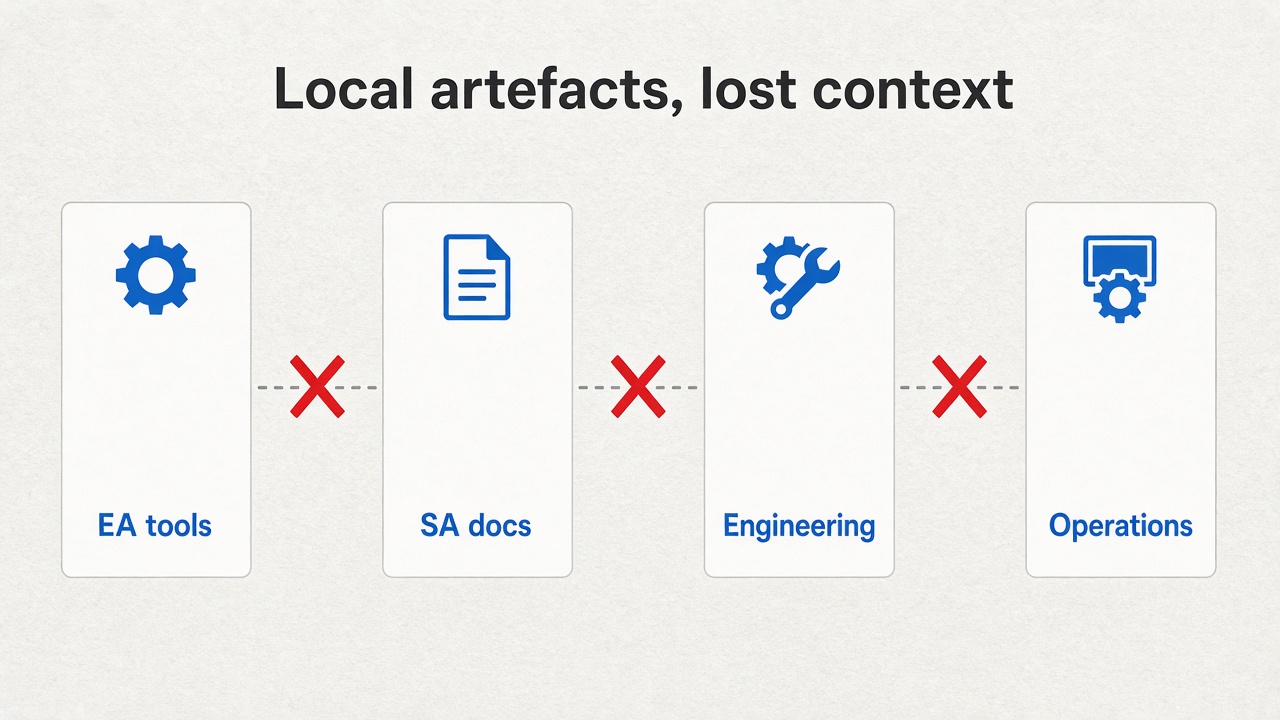
Typical failure modes:
- EA → SA: portfolio entities exist as thin factsheets; solution architects rebuild landscape understanding from scratch for every programme.
- SA → Engineering: design intent lives in decks and Confluence; implementation diverges without updating the enterprise view.
- Engineering → Operations: runtime topology and ownership drift from the intended architecture; blast-radius questions become tribal knowledge.
- Operations → EA: lived reality never feeds back into strategy models, so roadmaps argue from stale baselines.
Context is the missing carrier
A name and a relationship edge are not enough. Decisions require the how and why: constraints, alternatives considered, integration contracts, ownership nuances, and the evidence that justified a choice. That context is usually unstructured — in HLDs, workshop notes, transcripts, tickets, and people's heads — and it is exactly what traditional inventory-centric tools are designed to discard.
When context dies at the handoff, the continuum breaks. Teams compensate with more meetings, more documents, and more rediscovery. That cost is the organisational tax of a disconnected knowledge system.
What comes next
The following articles explain why classic enterprise architecture tools — valuable as they are for strategic governance — were never designed to be that connective tissue, and why DecisionPen frames itself as an Architecture Decision Workspace rather than another portfolio suite.