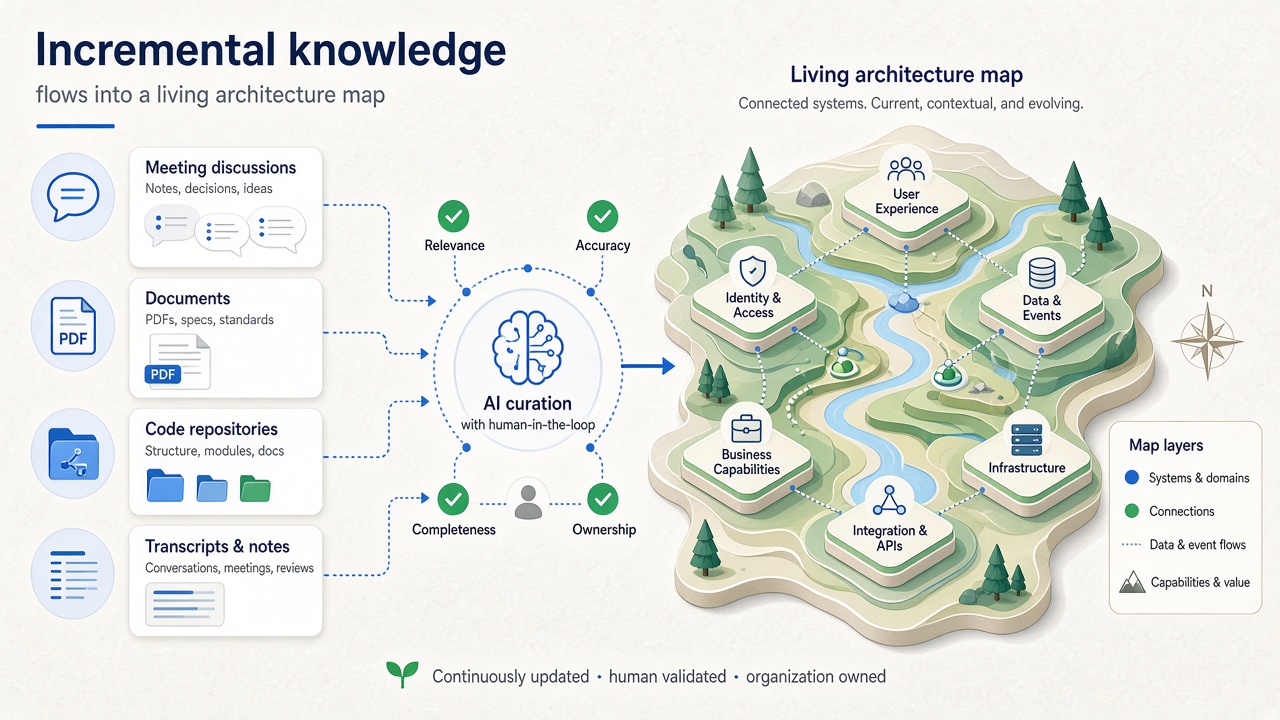
From empty repository to living synthesis
Traditional EA programmes often treat modelling as a project phase: gather inputs, type factsheets, declare a baseline, move on. DecisionPen treats modelling as an incremental synthesis that improves every time the organisation produces knowledge — which is constantly.
The unit of progress is not “the complete landscape.” It is a trusted update: a proposed set of entities, relationships, and evidence links that a human can accept, edit, or reject.
Inputs across the continuum
DecisionPen is designed to learn from the artefacts each quadrant already creates:
- Documents — HLDs, PDFs, wikis, design packs, and other structured prose that already encodes IT DNA.
- Meetings & transcripts — SME interviews, workshops, and architecture forums where the real constraints surface verbally.
- Narrative description — when documents are thin, an expert can describe a domain in natural language and still produce metamodel-compliant structure.
- Repositories & delivery signals — implementation truth that should challenge, not ignore, the intended architecture.
The loop
- Ingest — bring materials into the workspace.
- Propose — an agent interprets content against the metamodel: applications, capabilities, technologies, integrations, and relationships.
- Curate — architects and SMEs confirm, correct, or defer proposals (human-in-the-loop governance).
- Bind evidence — keep the how-and-why passages attached so the map remains explainable.
- Ask & act — interrogate the living map; generate artefacts; feed downstream systems when needed.
Because the loop is incremental, a partner or internal team can show a useful landscape in days rather than waiting months for “complete” inventory coverage that will be stale on arrival.
See DecisionPen in 90 seconds
Think ChatGPT or Gemini — but for your enterprise architecture. See how DecisionPen works as an Architecture Decision Workspace.
Ready to try it yourself?
See it liveMetamodel awareness matters
Generic summarisation is not enterprise modelling. DecisionPen’s proposals are constrained by architectural structure — so outputs remain relationship-aware and suitable for later sync or alignment with portfolio standards (including LeanIX-style factsheet thinking when that is the enterprise’s language of record).