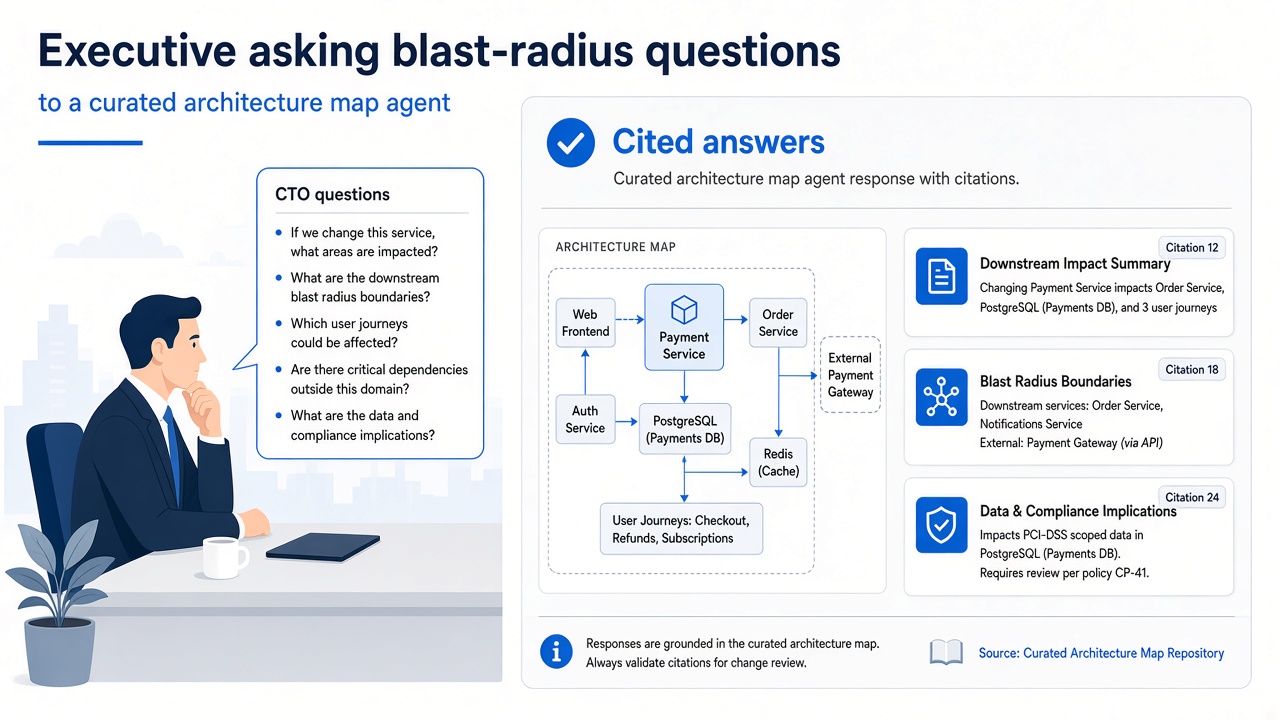
AI agents interrogate and deep-reason over an enterprise architecture map by treating it as a graph to be traversed, not a pile of text to be searched. A question like “what breaks if we retire this platform?” needs multi-hop reasoning — from an application to its integrations, to the capabilities it supports, to the owners and decisions attached — with each step grounded in curated entities and cited evidence. This post is about that reasoning. For which questions a CTO should ask, see what a CTO should ask an enterprise Ask agent.
What is the difference between searching and reasoning over a map?
Document search returns passages that resemble the query. Reasoning over a map follows relationships: it can answer questions whose answer is written in no single document because it emerges from how several curated facts connect.
- Search: “find text about the billing system.”
- Reasoning: “list everything downstream of the billing system, group by capability, and flag which links lack evidence.”
The second needs a metamodel (so “downstream” and “capability” mean something), curated relationships (so the traversal is trusted), and bound evidence (so the answer can be checked). That is the argument of enterprise architecture context applied to questions.
How does multi-hop reasoning work on an architecture graph?
A well-designed agent decomposes a question into steps that each touch the map:
- Resolve entities — turn “the CRM” into the specific application, avoiding look-alikes and retired names.
- Traverse relationships — follow integrations, dependencies, hosting, and capability links outward, hop by hop.
- Gather evidence — pull the How/Why attached to the entities and edges that matter for the question.
- Compose and cite — answer in prose or a structured list, with each claim linked to the entities and sources used.
- State the limits — say what the map does not know, rather than filling the gap with a plausible guess.
What is blast radius analysis?
Blast radius is the set of applications, integrations, capabilities, teams, and decisions affected if something changes. It is the canonical deep-reasoning question because it is inherently a graph traversal with a judgement layer on top.
Because the map is curated, the answer improves as the map improves — and the agent can point at the weakest links (edges with thin or conflicting evidence) as the next things to verify.
Why do citations matter more as reasoning gets deeper?
Every hop is a chance to compound an error. A confident five-step chain built on one stale relationship is worse than a short answer, because it looks authoritative. Citations make the chain inspectable:
- Reviewers can open the entity or document behind any step.
- Disagreements become corrections to the map, not arguments about the chatbot.
- Conflicting sources are surfaced instead of silently averaged.
- Gaps are named, which tells the team where to curate next.
What questions need deep reasoning rather than retrieval?
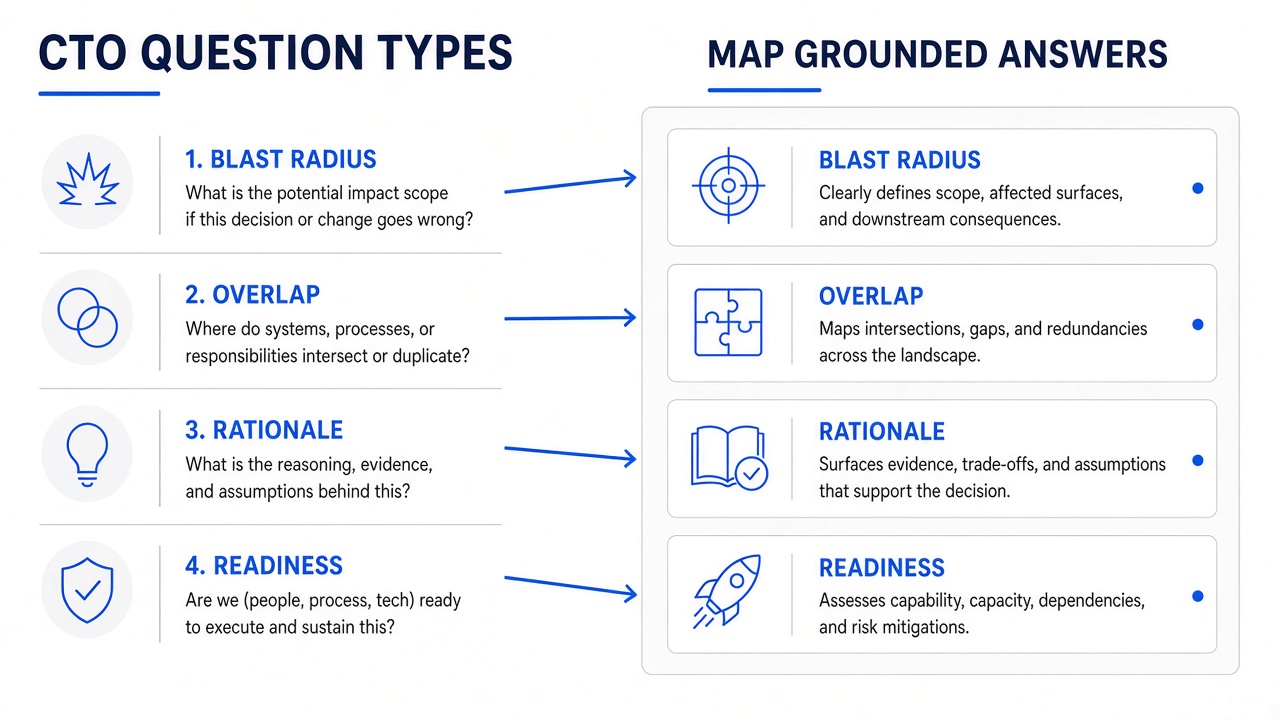
Without repeating a full question list, the pattern is consistent. Deep reasoning is warranted when the question is about:
- Impact — blast radius, change sequencing, retirement risk.
- Overlap and consolidation — comparing several entities against shared capabilities.
- Constraint checks — whether a proposed design violates a standard or an earlier decision.
- Readiness and gaps — what is undocumented or unowned on a critical path.
Plain document RAG handles some of these poorly because the connecting facts are not co-located in any passage — see why Copilot or plain RAG is not enough for EA and the contrast with a metamodel-aware agent.
How should humans stay in the loop?
Interrogation is read-heavy, but it generates signal. A good answer that exposes a wrong edge should feed a curation task, and an answer that is accepted as a decision basis should be recordable against the entities it concerned. The agent proposes; people ratify. Treat Ask as a discovery surface for map gaps, not only a query box.
How does DecisionPen solve this?
Enterprise Ask in DecisionPen is built on the curated map of an Architecture Decision Workspace.
- Metamodel-aware traversal — questions resolve to typed entities and relationships.
- Blast radius and impact views — multi-hop answers across applications, integrations, and capabilities.
- Citations — claims link back to entities and bound evidence.
- Honest gaps — missing or unevidenced links are shown, and become curation targets.
Trial DecisionPen with one real retirement or migration question and compare the traced, cited answer with what a document chatbot gives you.
When is DecisionPen not the right tool?
If your landscape is not modelled or curated and you do not plan to curate it, deep reasoning has nothing trustworthy to traverse. Also if you need live operational telemetry (runtime dependency tracing), a general-purpose chatbot, or a drawing canvas. DecisionPen reasons over curated architecture context; it does not replace observability or CMDB discovery tools.
What to read next
- What should a CTO ask an enterprise Ask agent?
- Enterprise Ask
- AI EA Copilot vs metamodel-aware agent
- How do you keep EA factsheets current with AI?
- How do you generate ADRs, blueprints, and diagrams?
Series index (AI in the Architecture Decision Workspace)
- D7a — What AI does inside an Architecture Decision Workspace
- D7b — Model EA from structured and unstructured sources with AI
- D7c — Review and curate AI-proposed architecture models
- D7d — ADRs, blueprints, and diagrams from context
- D7e — This post (deep reasoning over the map)
- D7f — Keep factsheets current with AI descriptions and relations