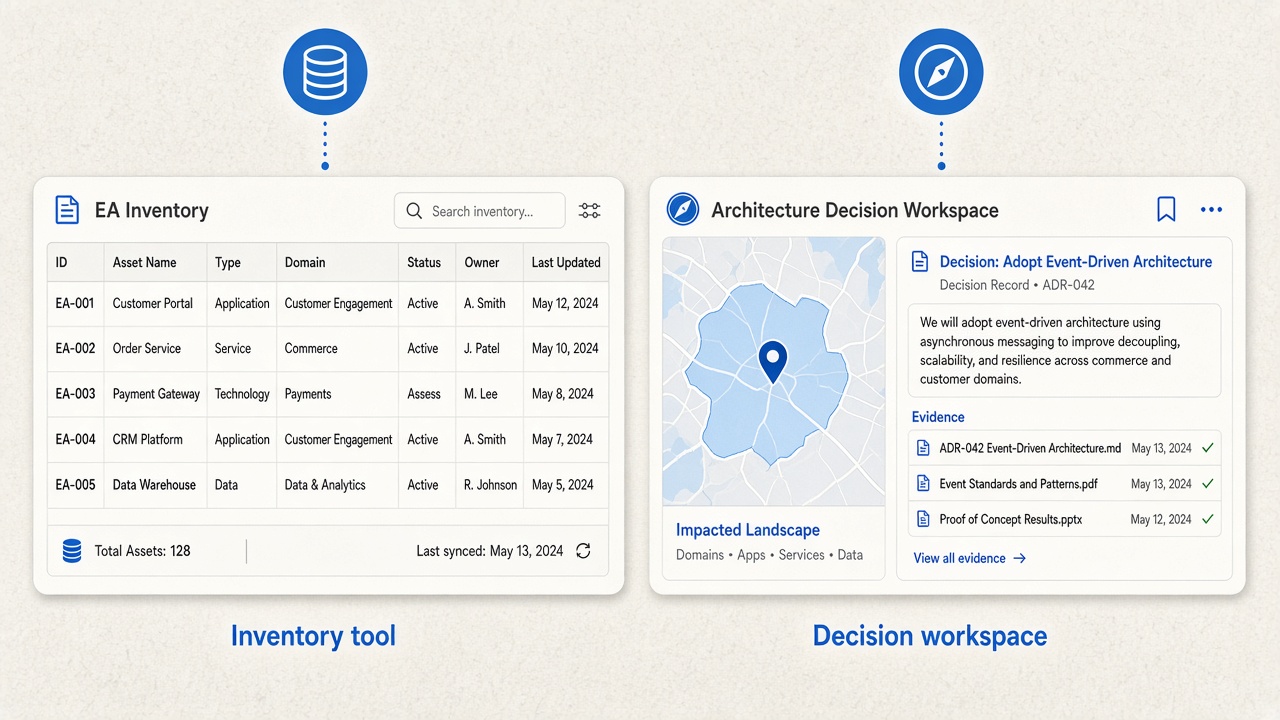
Most “AI for architecture” demos show a chat box over a folder of documents. An Architecture Decision Workspace uses AI differently: as a loop that proposes structure, binds evidence, waits for human curation, and then answers and publishes from the curated map. This post is the capstone map of that loop — what AI does at each step, what it deliberately does not do, and how it differs from chat-over-docs. It is the first of a short series on AI inside the workspace; the sibling posts go deep on modelling from structured and unstructured sources and human review and curation.
Why does “AI chat over documents” fall short for architecture?
Chat-over-docs answers a reasonable question — what do our documents say? — and it is useful for exactly that. Architecture work asks a harder one: what is authorised to be true of our landscape, and what follows if we change it? To answer that, an assistant needs more than similar paragraphs:
- A metamodel so an application, a technology component, and a capability are different things with valid relationships between them.
- A curated state — somewhere a decision to retire a system or reject an option is recorded and outranks an old wiki page.
- Evidence bound to claims, so a leader can ask “where did that come from?” and get a source, not a shrug.
- An owner: someone accountable for what joins the map.
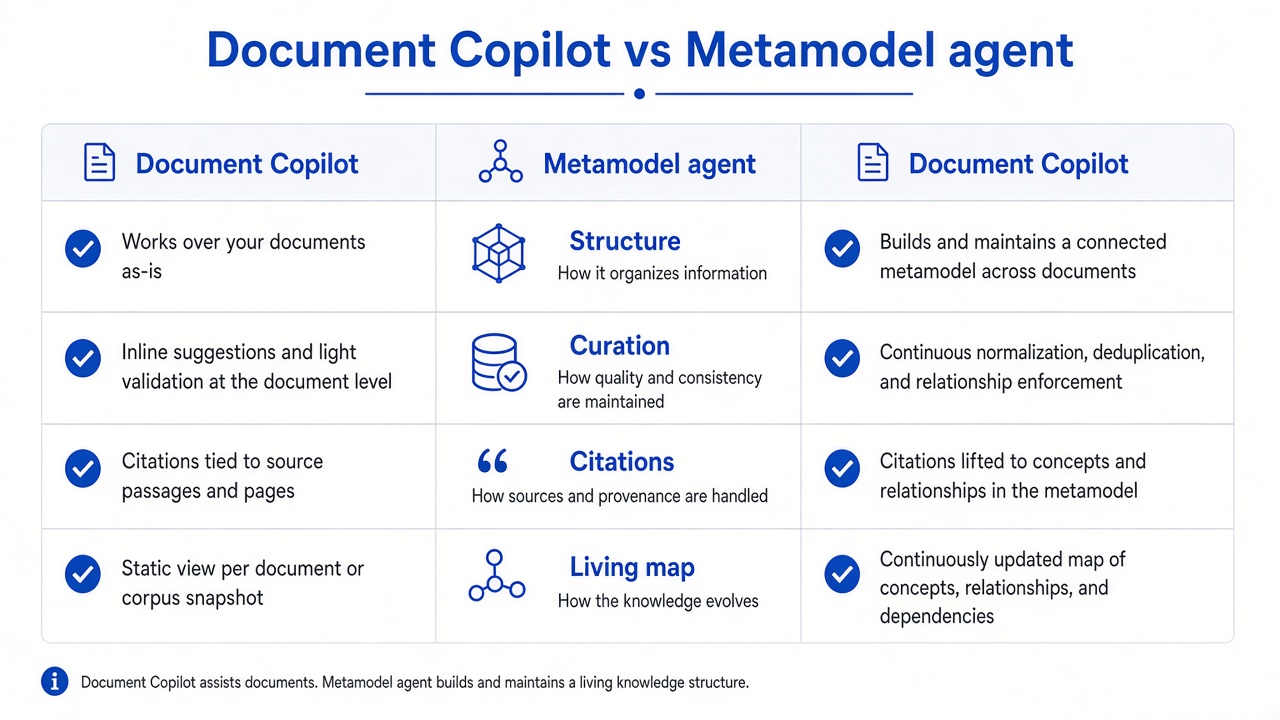
We cover the Copilot-versus-metamodel distinction properly in AI enterprise architecture: Copilot vs metamodel agent and the case for a shared plane in what is enterprise architecture context; here we assume the point and focus on the loop that fixes it.
What is the AI loop inside an Architecture Decision Workspace?
Think of five steps. AI does real work in four of them; in the fifth, the human is the point.
- Ingest — AI reads what your organisation already has: HLDs, PDFs, wiki exports, meeting transcripts, natural-language descriptions, and a CMDB or inventory spreadsheet extract.
- Propose — AI drafts metamodel-aware entities and relationships: applications, capabilities, technology components, integrations, and the links between them.
- Bind evidence — AI attaches the supporting passage or row to each proposal, so the How and Why travel with the What.
- Curate — humans accept, edit, reject, or defer. Only ratified proposals join the living map.
- Ask and publish — AI answers questions and drafts artefacts, but only from the curated map, with citations.
The ordering matters. The step that turns AI output into organisational fact — curation — sits before Ask and publish, not after. That is the practical meaning of Architecture Decision Workspace: a place where decisions are made against a curated state, with AI accelerating the work rather than replacing the accountability.
What does AI do at each step — and what does it not do?
Being explicit about boundaries is the fastest way to evaluate any vendor’s AI claim.
- Ingest and propose — AI does the transcription of enterprise reality into metamodel drafts, the work that otherwise becomes the Discovery Tax. It does not decide what is canonical.
- Evidence binding — AI keeps source and claim together. It does not invent provenance; an unsupported proposal should look unsupported.
- Curation support — AI can surface likely duplicates, conflicts between sources, and gaps. It does not auto-approve its own proposals into the Context of Record.
- Ask — Enterprise Ask answers from the curated map and cites it, and should say when the map has a gap. It does not improvise a topology to be helpful.
- Artefact generation — AI drafts documents and diagram images as views of the map (see documents as views of living context). It is not a freeform drawing canvas.
The acceleration story — why cycle time falls without governance collapsing — is told in how AI accelerates automated enterprise discovery; we will not repeat it here.
How does the loop change the solution architect’s job?
Solution architects are often the people closest to the real landscape and the least rewarded for writing it down. Their incentive is to ship the design, not to update a repository. That is why classic EA tools end up hollow: the artefact the architect has to produce (an HLD, a decision paper) and the artefact the repository wants (a clean factsheet) are two separate chores.
This is the practical answer to why solution architects rediscover the landscape: the work they already do stops being a one-way trip out of the repository.
How does the loop connect to shaped context and agentic delivery?
Once the map is curated, it has two more audiences. People consume it as shaped IT knowledge — views, answers, and generated documents drawn from one Context of Record (shaping context for IT knowledge management). Delivery agents consume it as scoped context packs before they act, and write accepted design outcomes back (architecture context for an agentic SDLC).
The point of the AI loop is therefore not a better chat window. It is a plane that both people and other agents can trust, so that every squad’s bot does not become a competing architecture office. The same loop, end to end, is described as a working method in from automated discovery to durable architecture context.
How should you evaluate “AI inside” claims?
Four questions separate a loop from a chat box:
- Does the AI propose against a metamodel, or only summarise text?
- Does every claim carry evidence you can open?
- Is there a human gate between AI output and the system of record?
- When the map has a gap, does Ask say so?
If the answer to any is no, you are buying retrieval with a friendly interface — useful, but not an Architecture Decision Workspace.
How does DecisionPen implement the AI loop?
DecisionPen is built around exactly this loop. It ingests documents, transcripts, natural-language descriptions, and a CMDB or inventory spreadsheet extract; proposes LeanIX-aligned entities and relationships where that is your modelling language; binds evidence; and puts proposals in front of architects to accept, edit, reject, or defer. Enterprise Ask and generated artefacts then draw on the curated map. The incremental mechanics are documented in incremental modelling, and the wider positioning in beyond traditional EA.
Trial DecisionPen on one contested domain, and compare a cited answer from the curated map with what a chatbot over the same documents says. That comparison is the fastest test of the loop.
When is DecisionPen not the right tool?
If you only need a freeform drawing canvas (Visio, Lucidchart), BPMN process modelling, a general writing Copilot, or a pure operational CMDB, DecisionPen is not the right primary tool. It holds living architecture context and can generate diagram images from it; it is not a document summariser alone, and it does not replace your IT service management system.
What to read next
- How do you model enterprise architecture from structured and unstructured sources with AI?
- How should humans review and curate AI-proposed architecture models?
- AI enterprise architecture: Copilot vs metamodel agent
- What is architecture context for an agentic SDLC?
- Why not Copilot or plain RAG for EA?
Series index (AI in the Architecture Decision Workspace)
- D7a — This map of the AI loop
- D7b — Model from structured and unstructured sources
- D7c — Human review and curation