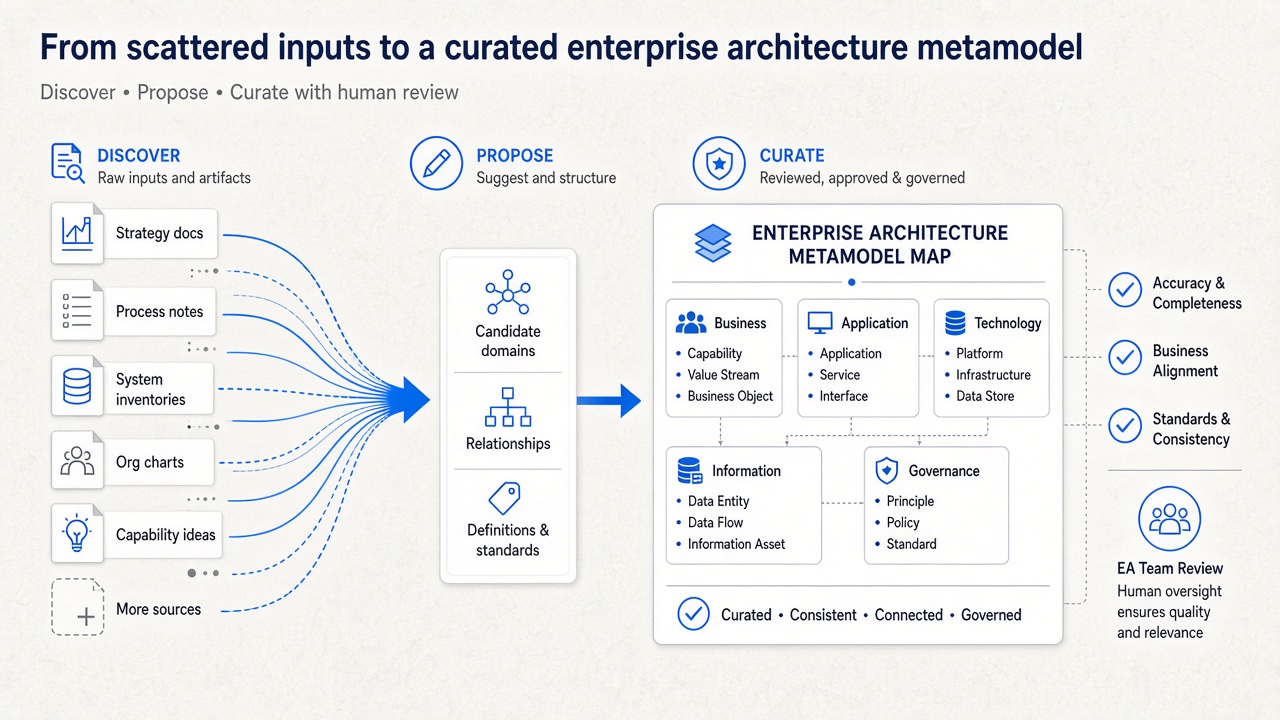
Every enterprise has the two kinds of source, and every modelling programme is tempted to pick one. Teams that start only from inventory get a tidy list with no How or Why. Teams that start only from documents get rich narrative with no stable identity. This post is about combining them with AI so the model grows from what you already hold — without pretending that AI makes the result self-authorising. For the wider AI loop, start with the capstone map; for the curation step in detail, see human review of AI-proposed models.
What are structured and unstructured sources in enterprise architecture?
The distinction is practical rather than academic.
- Structured — rows and columns with a schema: a CMDB export, an application inventory in a spreadsheet, a technology catalogue. Strong on what exists and its identifiers, owners, and lifecycle fields.
- Unstructured — prose and artefacts: high-level designs, solution architecture documents, wiki pages, meeting transcripts, decision emails, a paragraph typed into a chat. Strong on how things work and why they were chosen.
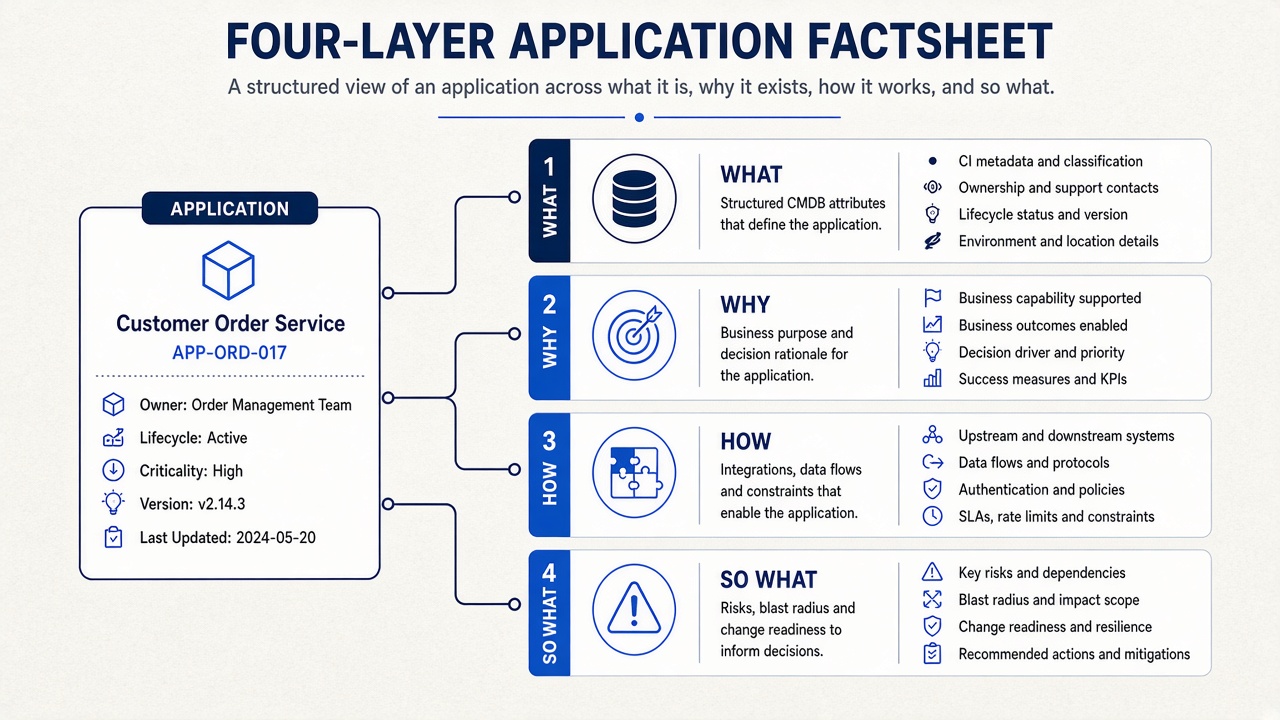
The mismatch between them is exactly why classic factsheets end up thin; we unpack that in why EA factsheets miss the How and Why.
Why does each source fail on its own?
Structured only. An inventory tells you that “Payments Gateway” exists and who owns it. It cannot tell you which capability it supports, what it integrates with, or why the organisation chose it over the alternative. Impact analysis on that foundation is guesswork.
Unstructured only. Documents describe systems in inconsistent vocabulary: the same application is “the gateway” in one HLD and “PGW” in another. Without an anchor list, AI proposals multiply near-duplicates, and curation becomes deduplication.
Together they complement: the structured source gives AI something to resolve names against, and the unstructured source gives the entities something to say. The approach mirrors combining top-down and bottom-up modelling.
How does AI propose entities and relationships from both?
A workable sequence looks like this:
- Scope a domain. Pick one contested area — payments, customer onboarding, a merger integration slice — not the whole estate.
- Seed identity from the structured extract. Import applications and technology components as the skeleton so canonical names and owners exist before narrative arrives.
- Ingest unstructured evidence. Add HLDs, wiki exports, transcripts, or natural-language descriptions for the same domain.
- Propose against a metamodel. AI drafts capabilities, integrations, data flows, and relationships — matching mentions to existing entities where it can and flagging new ones where it cannot.
- Bind evidence. Each proposal keeps its source passage or row, so a reviewer sees why the model thinks something is true.
- Curate. Architects accept, edit, reject, or defer.
- Repeat. The next document or next sprint adds to the same map.
The mechanics of steps 4–7 are described in incremental modelling, and the unstructured half in more depth in automated IT landscape modelling from unstructured data.
Why model incrementally rather than in one baseline?
A one-off baseline is a snapshot with a half-life. Incremental modelling treats every meeting, document, and design review as a small update to a living map. The measure of progress is trusted updates — a slice you would defend in a steering committee — not a percentage of estate “covered”. That is how the Discovery Tax falls (how AI accelerates discovery) without trading governance for speed.
It also removes the pressure to model everything before anyone can use anything. A curated slice of one domain can already ground Ask, generate a first set of artefacts, and support a real decision.
What goes wrong, and how do you avoid it?
- Duplicate entities. Seed identity first, and curate merges early so aliases resolve to one canonical entity.
- Over-eager relationships. A document that merely mentions two systems has not proven they integrate. Evidence binding lets a reviewer see the actual sentence.
- Stale sources. An old wiki page can contradict a retirement decision. Flag source dates and let curation record which claim wins.
- Unbounded ingestion. Dumping the entire intranet produces noise. Scope by domain, and add sources in waves.
- Treating AI output as fact. Proposals are drafts until ratified — see the curation guide.
How does the combined model stay LeanIX-aligned?
Many organisations already speak the LeanIX metamodel. Proposals can be aligned to those entity types where that is your modelling language, so what you build is compatible with how your EA function already thinks. We cover that case in generating a LeanIX-compliant enterprise baseline and the enrichment angle in enriching EA factsheets with unstructured documents.
How does DecisionPen model from both source types?
DecisionPen is an Architecture Decision Workspace built for exactly this combination:
- Spreadsheet import of a CMDB or inventory extract to establish the structured skeleton.
- Document and dialogue ingestion — HLDs, PDFs, wiki exports, transcripts, and natural-language modelling.
- Metamodel-aware proposals with bound evidence, rather than free-text summaries.
- Human curation before anything becomes canonical.
- Enterprise Ask and artefacts from the curated map (Enterprise Ask).
Trial DecisionPen with one inventory extract and three or four documents for the same domain. Count how many proposals you accept as-is, edit, and reject — that ratio is your real measure of fit.
When is DecisionPen not the right tool?
If you need live, bi-directional synchronisation with ServiceNow or another CMDB, a network or SaaS scanner, a freeform diagramming canvas (Visio, Lucidchart), BPMN process modelling, or a Copilot that only drafts text, DecisionPen is not the right primary tool. It adds the curated architecture layer — it does not replace your operational CMDB.
What to read next
- What does AI actually do inside an Architecture Decision Workspace?
- How should humans review and curate AI-proposed architecture models?
- Automated IT landscape modelling from unstructured data
- How does AI accelerate automated enterprise discovery?
- How automated enterprise architecture modelling works
Series index (AI in the Architecture Decision Workspace)
- D7a — The AI loop, mapped
- D7b — This post (structured + unstructured sources)
- D7c — Human review and curation