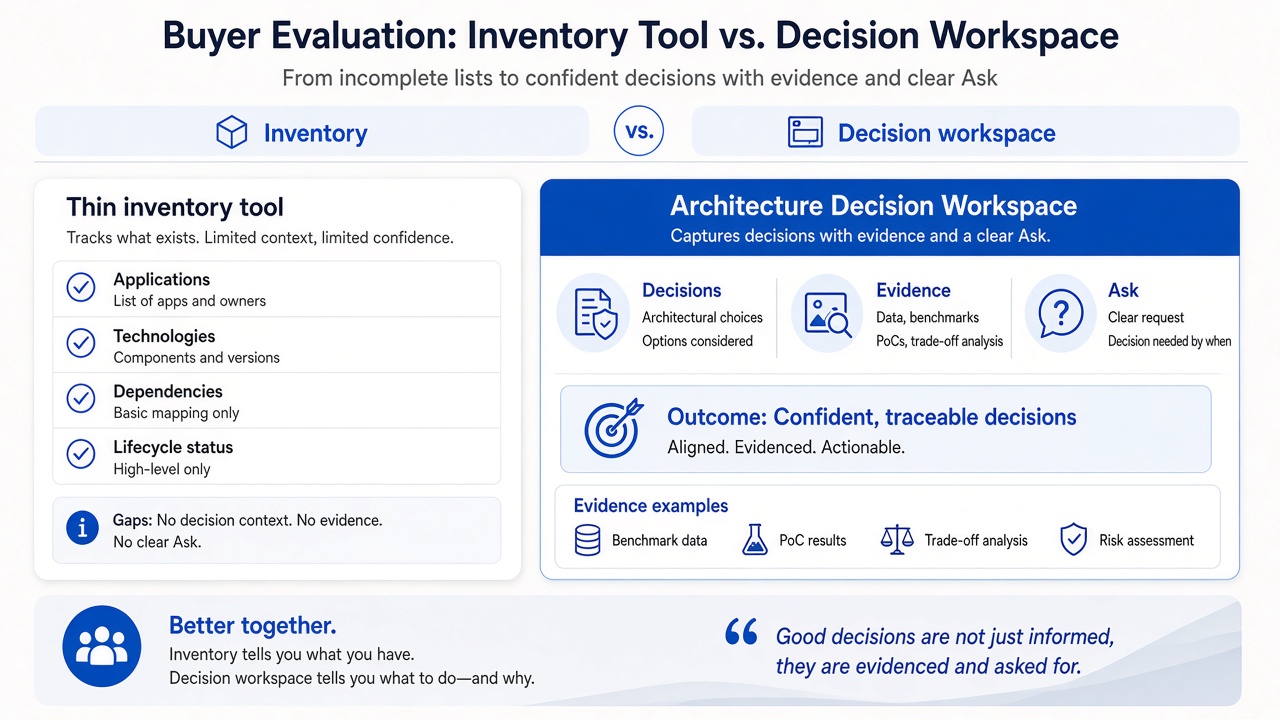
What changed about choosing an EA tool by 2026?
Metamodel checkboxes are table stakes. AI coding and copilots outrun stale inventories. Buyers now ask: will this stay empty?, can we keep How and Why?, can we ask the landscape with evidence?, DecisionPen vs traditional EA tools. The shortlist criteria shifted from “reporting library” to “decision workspace.”
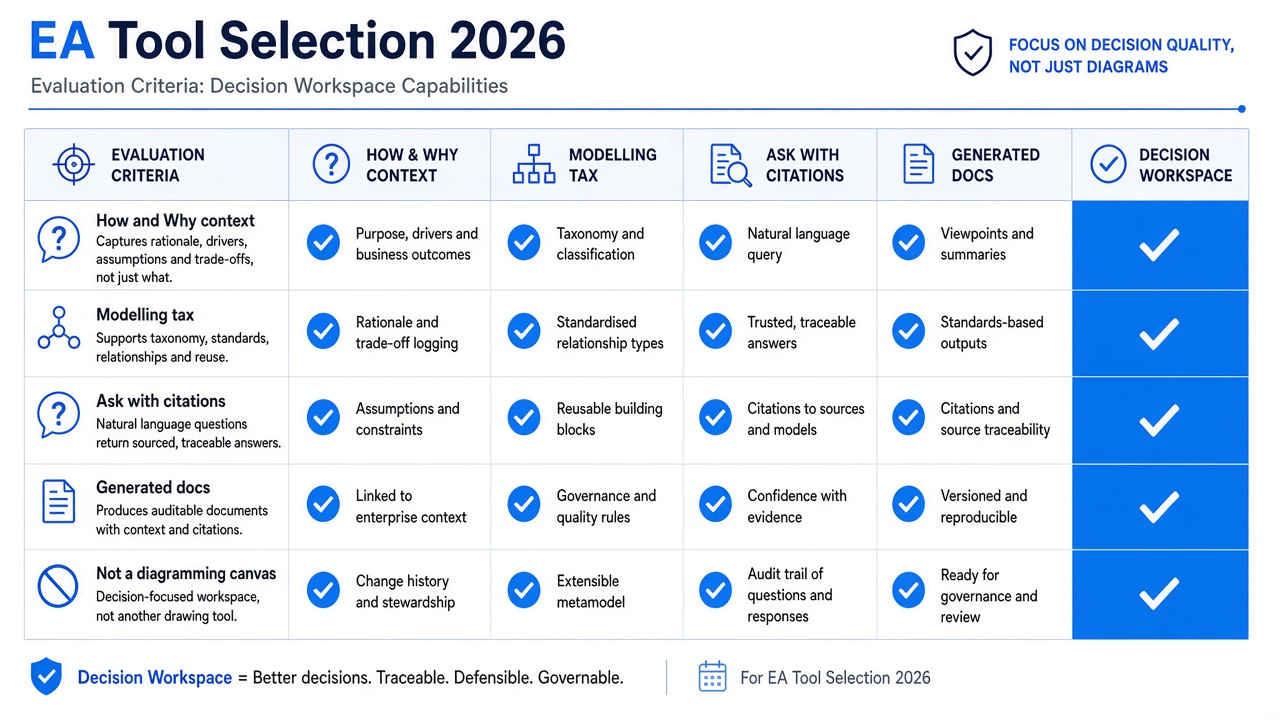
What should you evaluate in 2026?
- How and Why with the What — evidence bound to entities, not only thin factsheets (factsheets vs How and Why).
- Modelling tax — incremental intake from documents and meetings vs blank-form programmes (automated discovery).
- Ask with citations — map-grounded answers, not ungoverned chat (Copilot vs metamodel agent).
- Docs as views — generate artefacts from living context; SA handoff that does not restart discovery.
- Honest boundaries — full EA modelling scope where claimed; clear when the product is not Visio/BPMN.
- Agentic-era ownership — who owns enterprise context when every team has a bot (EA must own context).
How does DecisionPen solve this (on a shortlist)?
DecisionPen is built to pass the 2026 criteria above — not only to claim a metamodel.
- Full EA modelling scope — applications, capabilities, technology, integrations, roadmaps/reporting, with LeanIX metamodel support; complement or switch depending on operating model.
- Unstructured evidence with structure — How/Why stays with entities in the ADW.
- Incremental modelling — propose from docs/meetings; humans curate.
- Enterprise Ask — map-grounded Q&A with citations.
- Template artefacts — generate docs from living context; close the EA–SA loop.
Shortlist with a hands-on trial: one system of interest, real documents, one Ask question, one generated view — score vendors the same way.
When is DecisionPen not the right tool?
Primary need is freeform diagramming/BPMN or a pure ops CMDB. Use Visio/Lucid for drawing; use DecisionPen for curated living architecture context and decisions.