What do people mean by automated EA discovery?
Usually: “stop typing factsheets — populate the landscape from what we already have.” Search phrases sound like auto populate EA repository from documents, automated IT landscape mapping, EA discovery vs CMDB. The phrase is overloaded. Some vendors mean a scrape. Some mean chat over PDFs. Useful discovery means something stricter.
What automated EA discovery is (and is not)
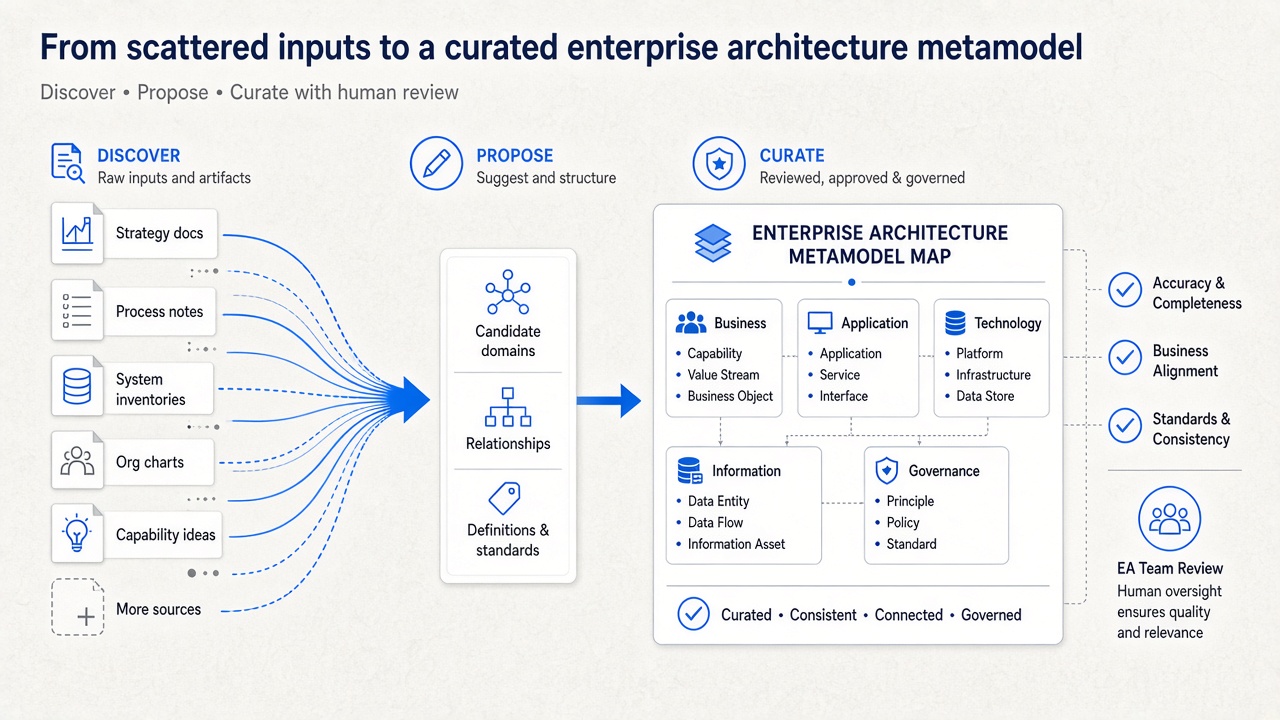
It is: software that proposes metamodel-aware entities and relationships from documents, meetings, transcripts, and related signals — then humans curate those proposals into a living map you can ask and act on.
It is not: a one-shot CMDB dump that lists assets without How/Why; or plain document RAG that retrieves passages without governed structure (why not Copilot or RAG alone).
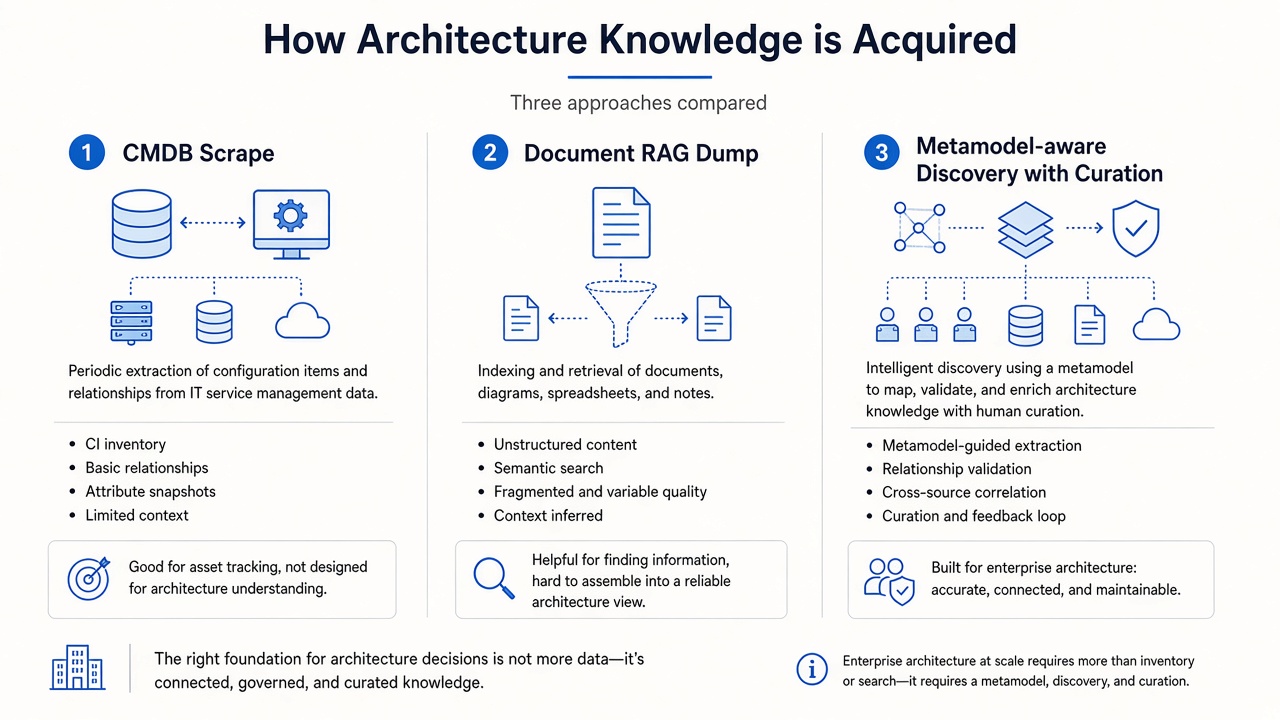
Why discovery has to beat the Discovery Tax
Manual baselines are why architects hate modelling and why repositories stay empty — see why architects hate manual EA modelling. Automation that still produces thin factsheets without evidence just accelerates hollowness (factsheets vs How and Why).
How does DecisionPen solve this?
DecisionPen implements discovery as incremental modelling — continuous synthesis, not a mythical complete scan.
- Ingest — HLDs, PDFs, wikis, transcripts, natural-language domain descriptions.
- Propose — metamodel-compliant applications, capabilities, technologies, integrations, and relationships (LeanIX-aligned where that is your language).
- Curate — architects accept, edit, reject, or defer; trusted updates beat “100% inventory.”
- Bind evidence — How/Why passages stay attached so the map stays explainable.
- Ask & act — Enterprise Ask and generated artefacts use the curated result.
Trial DecisionPen on one domain’s documents — prove a useful discovered slice in days, not a year of data entry.
When is DecisionPen not the right tool?
If you only need freeform diagramming/BPMN (Visio, Lucidchart) or a pure ops CMDB. DecisionPen is for curated living architecture context and generated views — not a drawing canvas or asset database.