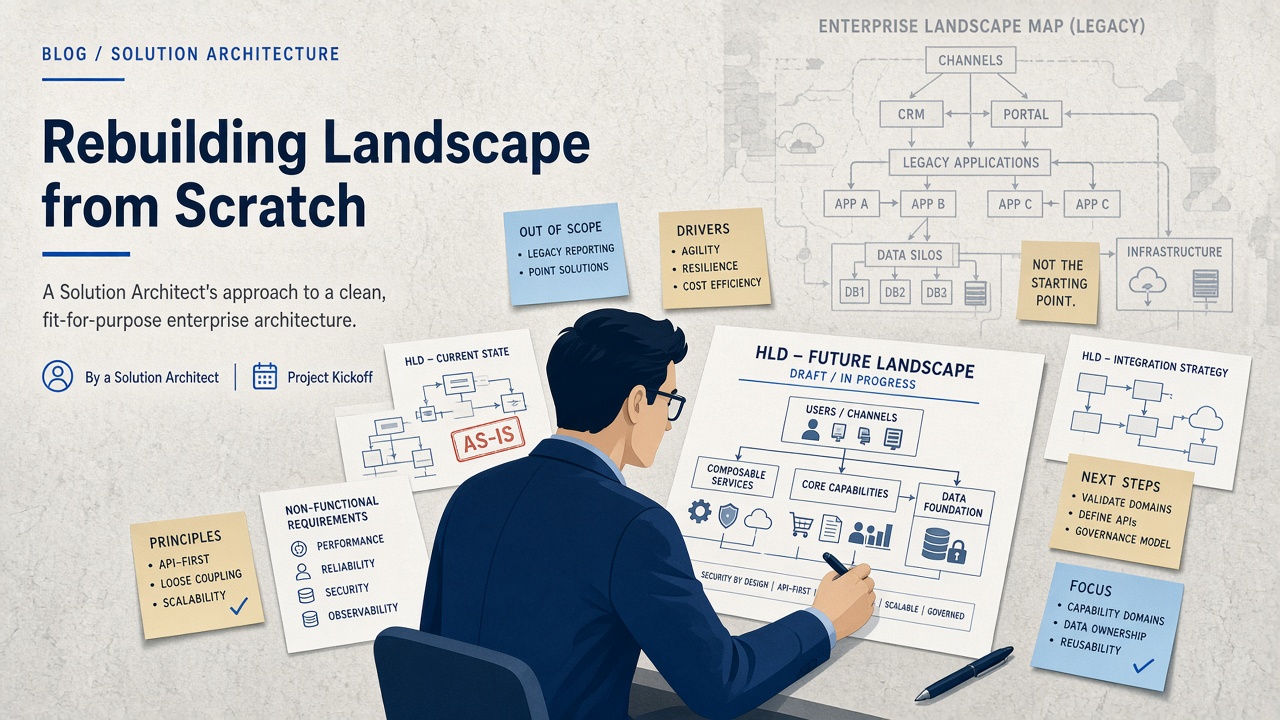
Why does every project feel like starting from zero?
Solution architects are asked to design change on a landscape they were never given in usable form. The EA repository may list systems, but not the How and Why needed for an HLD. So each programme restarts interviews, whiteboards, and document archaeology — paying the Discovery Tax again.
People search for: EA to SA handoff, why do we rebuild architecture every project, inherit enterprise context for solution design. The pattern is structural, not personal failure.
What breaks the handoff from enterprise to solution architecture?
- Thin factsheets without behaviour or rationale (How and Why missing).
- Stale models nobody trusts, so SAs ignore them.
- No path for project learning to flow back into enterprise memory — so the next programme rediscovers the same facts.
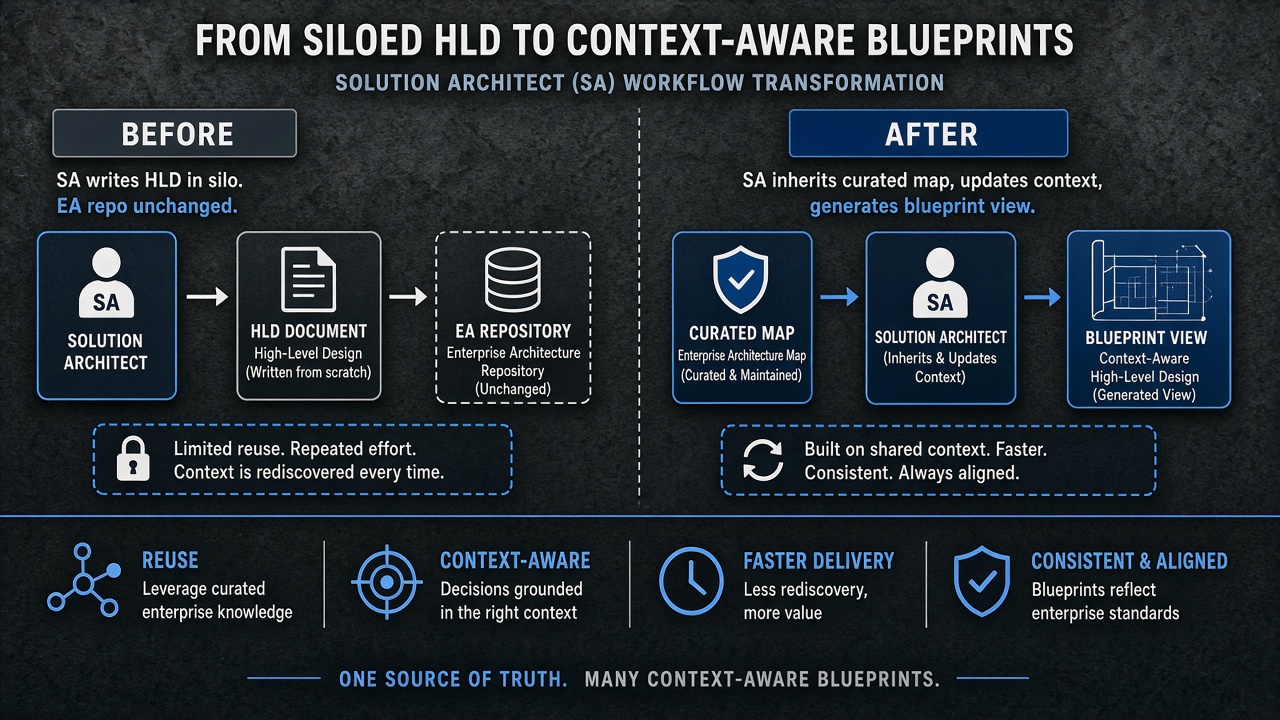
What should a healthy EA–SA loop look like?
SAs inherit a curated slice of the living landscape, design against it, generate artefacts as views of shared truth, and contribute updates back — instead of parallel private HLDs that die in SharePoint. That loop is described in DecisionPen for solution architects and the IT Knowledge Continuum.
How does this connect to manual modelling pain?
If populating the enterprise map is clerical and incomplete, SAs will never inherit anything worth using. Fixing manual modelling incentives and fixing SA rediscovery are the same continuum problem.
How does DecisionPen solve this?
DecisionPen closes the EA–SA loop so projects inherit context and contribute back — instead of rebuilding the landscape in every HLD.
- Inherit a curated slice — start a programme from applications, integrations, capabilities, and linked evidence already on the map (solution architects).
- Generate artefacts from templates — HLDs, interface catalogues, ADRs as views of shared truth, not parallel private docs (generate docs from living context).
- Write design decisions back — accepted updates enrich the living model so the next programme does not rediscover the same facts.
- Ask before you whiteboard — map-grounded Ask reduces interview archaeology for questions the enterprise already answered.
Trial DecisionPen with one active project’s documents and see inheritance work before you commission another blank discovery.
When is DecisionPen not the right tool?
When the job is freeform diagram drawing — Visio, Lucidchart, or a BPMN canvas. DecisionPen is for living context and generated artefacts, not a drawing board.