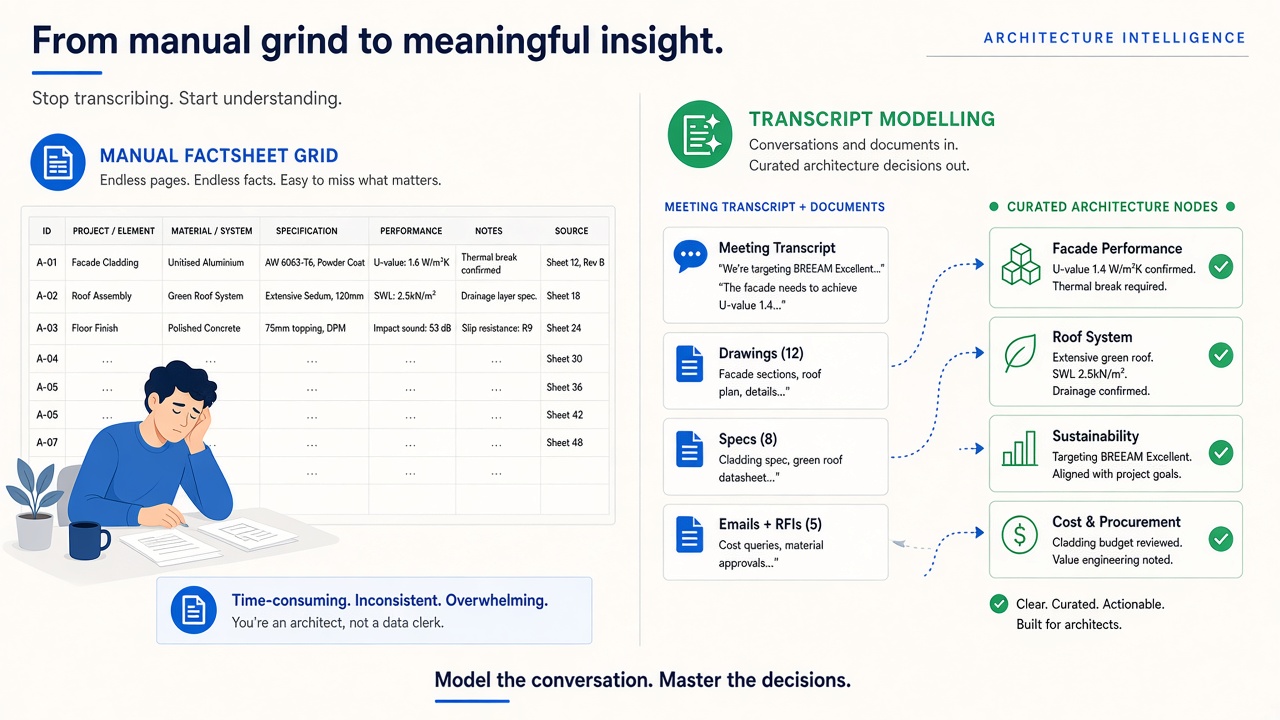
Why do architects resist filling EA factsheets?
Not because they dislike structure. Because manual modelling asks senior people to retype what already exists in documents, meetings, and HLDs — while the resulting inventory still lacks How and Why. The incentive fails; the repository stays empty or stale. That is the Discovery Tax paid as data entry.
Common questions: why is our EA repository empty, how do we populate an enterprise architecture tool, can we automate EA modelling from documents. Those are the right questions.
What does “easy” EA modelling have to mean?
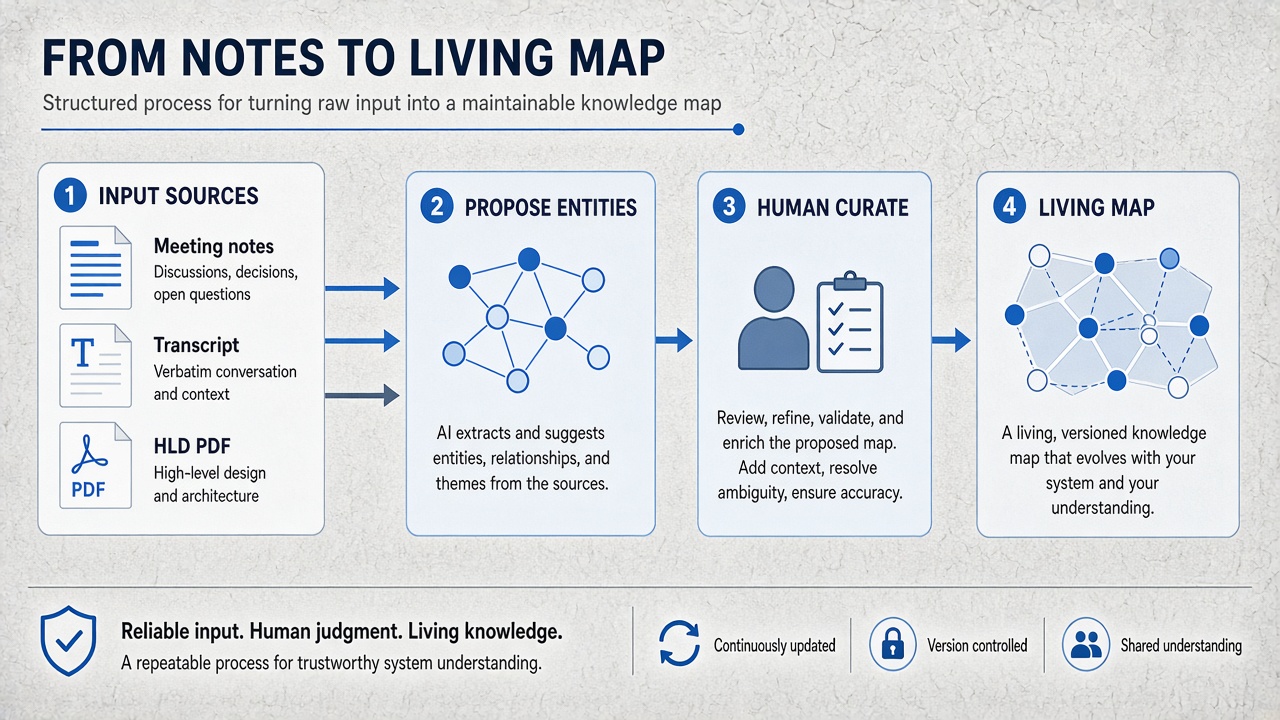
Easy cannot mean “another blank form.” It must mean: start from transcripts, notes, and documents; propose metamodel-aware entities and relationships; let experts curate instead of invent from memory. That is incremental modelling.
Is automated modelling the same as dumping PDFs into an LLM?
No. Retrieving passages (RAG) is not the same as proposing structured applications, interfaces, and capabilities you can review into a living map. Automation without a metamodel and human curation recreates document chaos with better prose. See why not Copilot or plain RAG alone.
What happens if modelling stays manual?
Baselines take months, drift starts immediately, solution architects ignore the repository, and tribal knowledge remains the real system of record. Traditional EA scope alone does not fix the empty-repo loop — see beyond traditional EA.
How does DecisionPen solve this?
DecisionPen removes the clerical tax: propose structure from what the organisation already produces, then ask architects to curate — never to retype the landscape from blank forms.
- Ingest meetings and documents — transcripts, HLDs, wikis, and natural-language descriptions become modelling inputs (incremental modelling).
- Metamodel-aware proposals — the agent suggests applications, capabilities, technologies, and relationships (including LeanIX-aligned structures where that matters).
- Human-in-the-loop curation — accept, edit, reject, defer. Progress is trusted updates, not “complete inventory by Q4.”
- Evidence stays attached — so the model does not collapse back into thin factsheets the week after population.
Try it on one domain you already understand — prove a useful map slice without a months-long data-entry programme.
When is DecisionPen not the right tool?
If drawing architecture or BPMN diagrams is the primary job, use Visio or Lucidchart. DecisionPen generates diagram images from curated context; it is not a freeform drawing board.