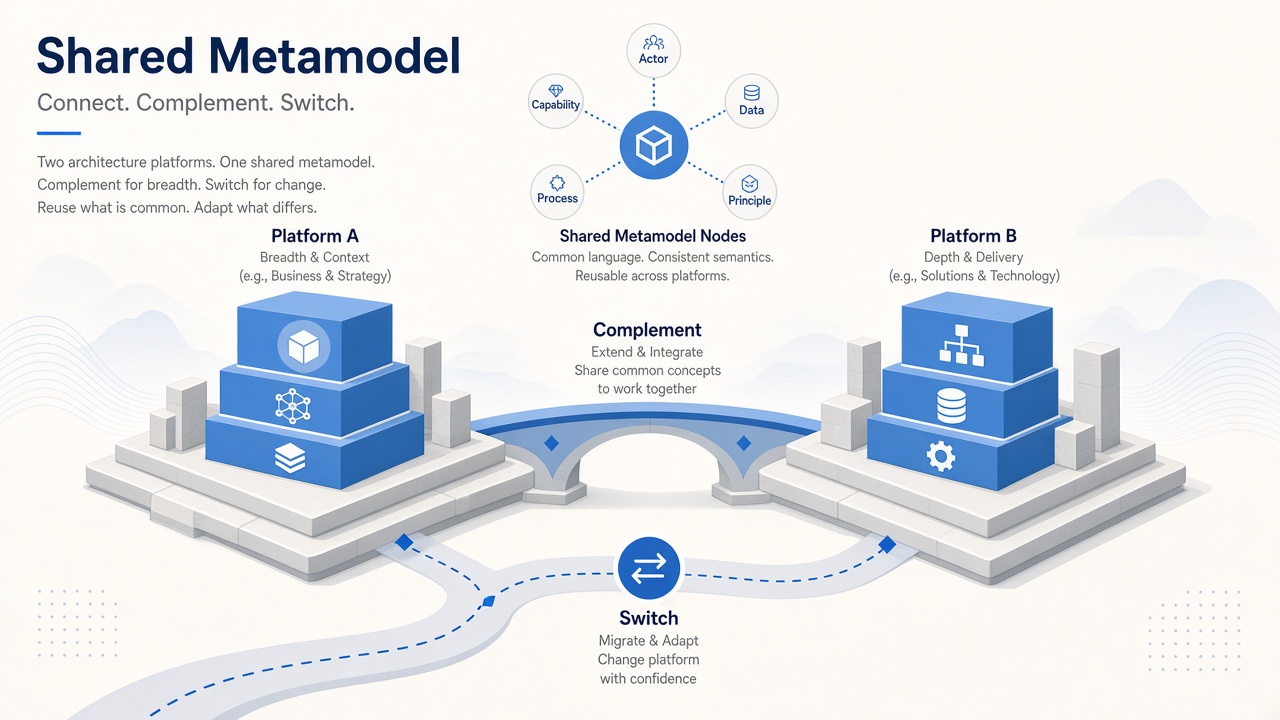
A LeanIX-compliant enterprise baseline is a curated starting landscape shaped to that metamodel — Applications, IT Components, Business Capabilities, and related factsheet types — not a pile of names scraped from PDFs. You can automatically generate most of the draft with AI from CMDB extracts and documents, then curate. Search clusters around populate LeanIX from documents, LeanIX baseline from CMDB, and speed up LeanIX discovery.
What “LeanIX-compliant” should mean
Compliance here is metamodel alignment, not a certification sticker. A useful baseline:
- Uses LeanIX-style factsheet types and relationship patterns your organisation already recognises.
- Distinguishes applications from technology components and capabilities — not a flat spreadsheet of “systems.”
- Carries enough How/Why evidence that portfolio and transformation questions are answerable (enrich factsheets with unstructured documents).
- Is curated before it is treated as production truth.
Why LeanIX programmes stall without this
Tooling is rarely the blocker; Discovery Tax is. Teams buy an EA platform, then spend months interviewing and typing factsheets while the workspace stays empty. Inventory connectors help with “what is deployed,” but HLDs, wikis, and SME narrative still hold intent and dependencies — the knowledge-discovery gap described in how AI accelerates automated enterprise discovery.
A practical generation method
- Bound the scope — one domain, value stream, or acquisition slice. Baselines fail when the first milestone is “the whole enterprise.”
- Seed structure — import a CMDB or inventory spreadsheet where it exists (applications / tech lists as a skeleton).
- Ingest evidence — HLDs, architecture decks, wiki exports, interview notes for the same scope.
- Propose — AI maps content to LeanIX-aligned types and relationships, binding source passages to candidates (automated EA discovery).
- Curate — architects accept, merge duplicates, reject noise, and mark unknowns. Trusted slice beats 10,000 unreviewed rows.
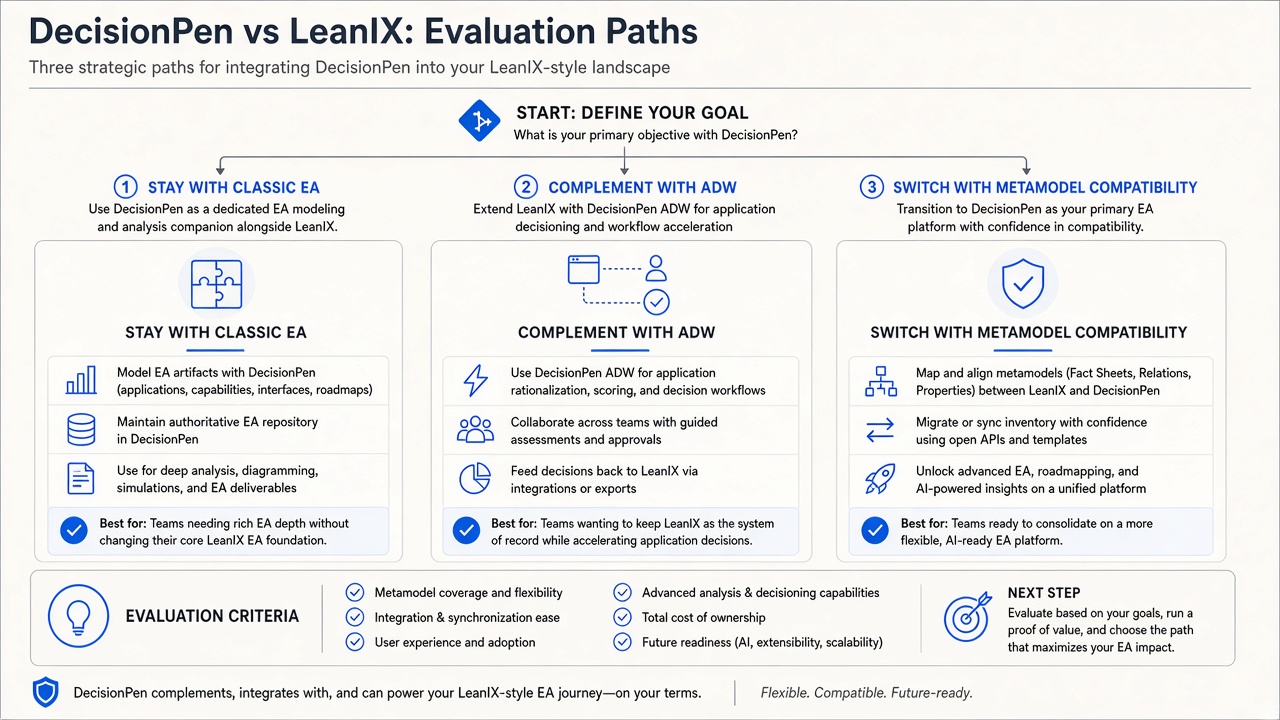
- Use and extend — Ask the map, generate artefacts, then widen scope. Optionally complement an existing LeanIX workspace or migrate when one ADW should own living context (DecisionPen vs LeanIX: complement or switch).
For a calendarised cold-start, see start EA from documents in 30 days.
What automation should not promise
- Silent production load — proposing ≠ publishing every candidate into LeanIX without review.
- Connector parity — document/CMDB knowledge discovery does not replace SAP SaaS discovery inboxes; it fills the narrative gap those integrations leave.
- Complete How/Why from inventory alone — CMDBs rarely store design rationale; documents and curation still matter.
How does DecisionPen generate a LeanIX-aligned baseline?
DecisionPen is an Architecture Decision Workspace with LeanIX metamodel support:
- Start from inventory spreadsheet and/or unstructured documents.
- AI proposes Applications, capabilities, technology, and links in a LeanIX-familiar shape.
- Humans curate; evidence stays bound for Enterprise Ask and generated views.
- Operate as discovery on-ramp beside LeanIX, or as the primary living workspace — see DecisionPen vs traditional EA.
Trial DecisionPen on one domain’s inventory + HLD pack — judge the curated baseline against your last manual LeanIX population cycle.
When is DecisionPen not the right tool?
If the job is only configuring LeanIX’s native SaaS/SAP discovery connectors, network scanning, or freeform Visio/BPMN drawing. DecisionPen accelerates knowledge discovery into a LeanIX-shaped baseline and living context — it is not LeanIX administration itself.