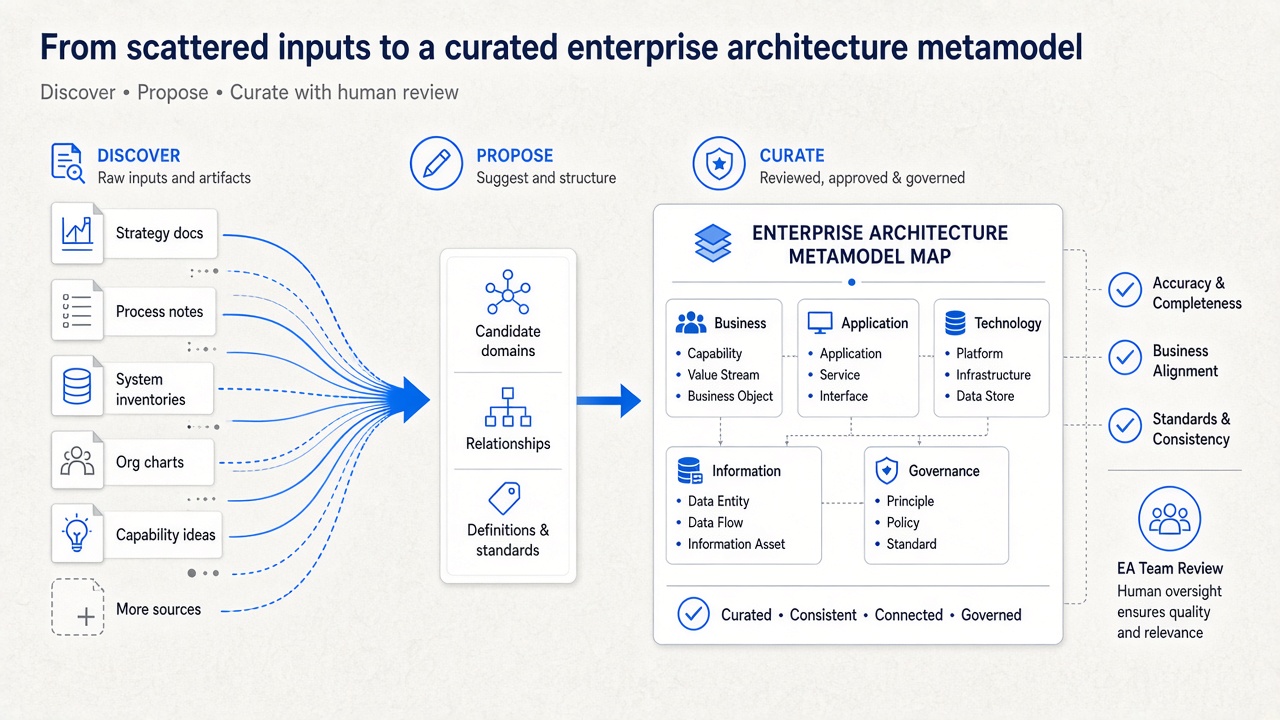
AI accelerates automated enterprise discovery by proposing metamodel-aware entities and relationships from documents, dialogue, and inventory extracts — then humans curate. The measurable gain is cycle time and coverage, not unsupervised truth. Search intent clusters around AI for enterprise architecture discovery, reduce Discovery Tax with AI, and auto-populate EA from documents.
What “accelerate” means (and what it does not)
Acceleration is not “skip the architects.” It is shifting scarce expert time from data entry to judgement. Manual baselines burn months of workshops and factsheet typing — the Discovery Tax — while decisions wait on an empty repository. AI that only summarises PDFs into chat still leaves you without a governed landscape (enterprise architecture context).
Where AI compresses the discovery loop
Relative to classical automated enterprise architecture discovery, AI typically accelerates five steps:
- Ingest at scale — HLDs, wikis, transcripts, RFP packs, and notes become inputs in hours, not interview calendars.
- Propose entities — candidate applications, capabilities, technologies, and integrations against an EA metamodel (LeanIX-aligned where that is the organisation’s language).
- Propose relationships — dependency and realisation links that workshops often miss or defer.
- Bind evidence — How/Why passages stay attached so curation is explainable, not a black-box dump.
- Seed from inventory — CMDB or spreadsheet extracts become a structured skeleton that documents then enrich, rather than a competing second truth.
Humans still accept, edit, reject, or defer. That is incremental modelling, not a mythical complete scan.
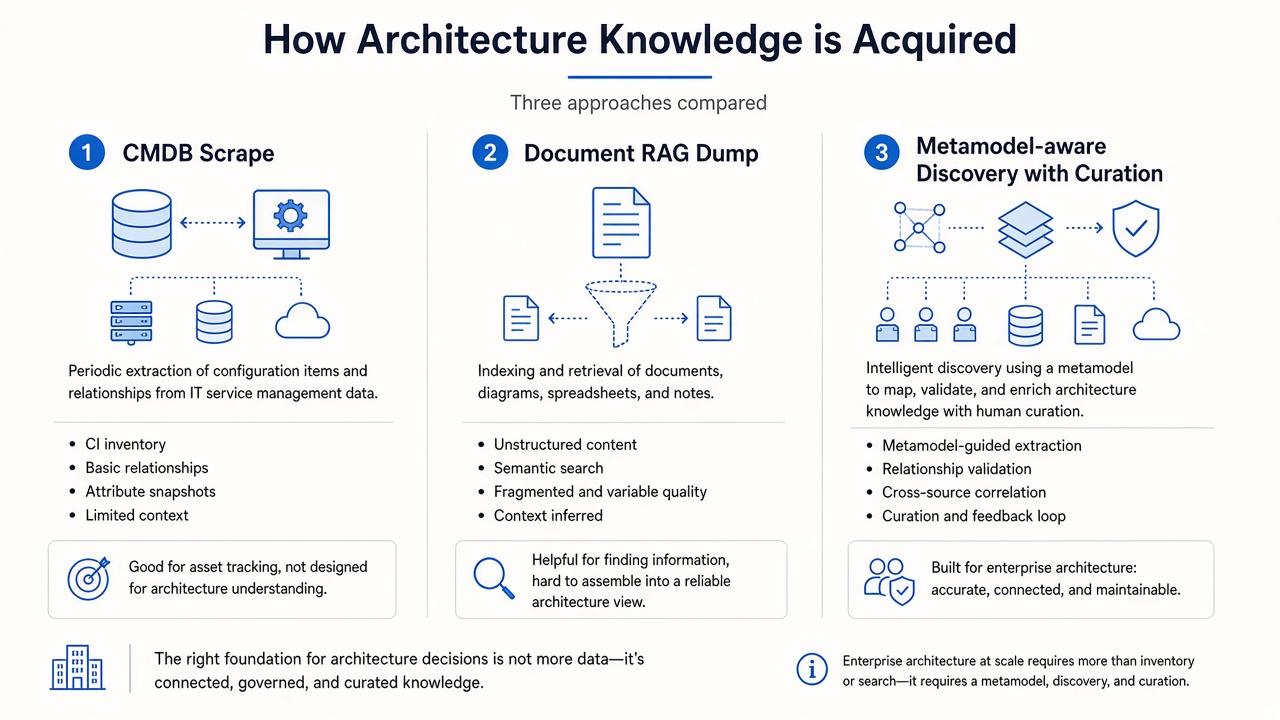
Two kinds of “discovery” — do not conflate them
Buyers and vendors use the same word for different mechanisms:
- Inventory / integration discovery — SaaS SSO catalogues, SAP landscape connectors, network or agent registries. Strong at “what is deployed or subscribed.”
- Knowledge discovery — extracting landscape meaning from unstructured institutional memory (documents, meetings, SME narrative) into a metamodel with evidence.
AI accelerates both in different products. DecisionPen’s wedge is knowledge discovery and factsheet enrichment — the work that usually stalls LeanIX-style baselines when the estate lives in HLDs and heads. Many programmes eventually want inventory and knowledge discovery; starting with documents still beats waiting for perfect integrations.
Why acceleration without a metamodel fails
A writing Copilot over Confluence can feel fast and still produce confident fiction about dependencies. Without metamodel constraints and curation, you get retrieval theatre — see Copilot vs metamodel agent and why plain RAG is not enough. Acceleration that ignores structure merely moves the Discovery Tax into downstream rework.
What “faster” looks like in practice
- Time-to-first-trusted-slice — days for a bounded domain instead of a quarter of blank factsheets.
- Curation ratio — experts review proposals instead of typing every attribute from scratch (why architects hate manual modelling).
- Evidence density — How/Why stays with the What, so Ask and artefacts inherit citations rather than orphan PDFs.
- Continuity — new documents update the living map instead of restarting discovery for every programme (automated IT landscape modelling).
How does DecisionPen use AI for discovery?
DecisionPen implements AI-accelerated discovery inside an Architecture Decision Workspace:
- Ingest — documents, natural-language domain descriptions, and optional CMDB/inventory spreadsheet seeds.
- Propose — metamodel-aware entities and relationships.
- Curate — architects remain stewards of record.
- Ask & act — Enterprise Ask and generated artefacts use the curated map, turning discovery into durable architecture context.
Trial DecisionPen on one domain’s notes or inventory extract — measure days to a curated, askable slice against your last manual baseline.
When is DecisionPen not the right tool?
If you only need packet-level network scanning, a pure ops CMDB, or freeform Visio / Lucid / BPMN drawing. DecisionPen accelerates curated architecture discovery and living context — not a discovery scanner or diagramming canvas.