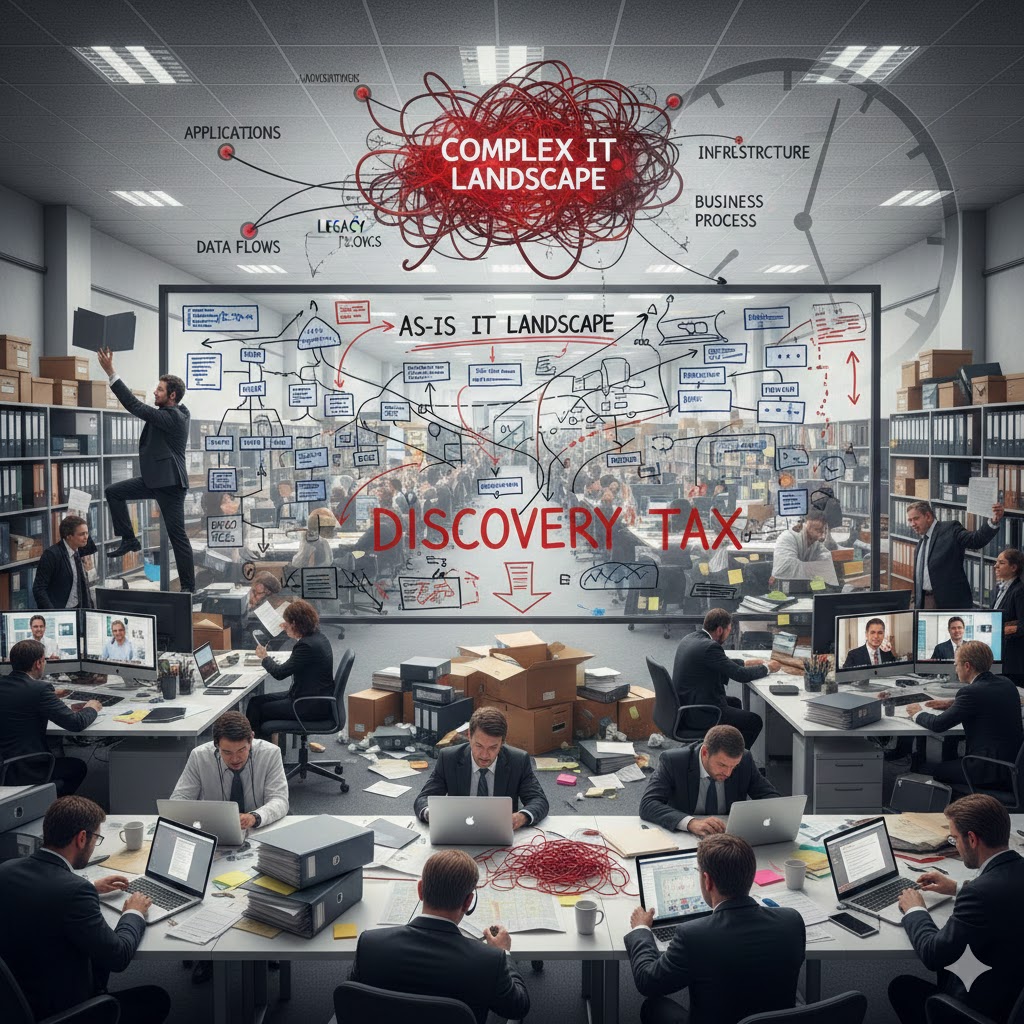
The Context Tax is the recurring cost of every team and agent re-assembling IT landscape truth — what exists, how it connects, who owns it, why it was designed that way — from wikis, tickets, and tribal memory instead of inheriting a curated architecture Context of Record. It is the twin of the Discovery Tax in the agentic era.
What is the Context Tax?
Unlike a one-off project overrun, Context Tax compounds: the same dependency question is answered differently by three squads and two bots — each confident, each citing a different Confluence page.
Discovery Tax vs Context Tax
- Discovery Tax — up-front cost of building an as-is baseline (workshops, archaeology, blank factsheets). Paid heavily at programme start.
- Context Tax — ongoing cost of not reusing that baseline. Paid every time a human or agent rebuilds landscape understanding from scratch.
Automating discovery without owning context merely shifts the bill: you populate a repository once, then still pay Context Tax when nobody asks the living map (EA must own enterprise context).
Where the Context Tax shows up
- Solution architects rediscover the estate on every project (SA rediscovery).
- Delivery teams escalate to key people (“let me check with Dave”) because the map is empty or untrusted.
- Transformations and M&A re-baseline under time pressure instead of extending shared memory.
- AI agents each retrieve a private document pile, invent integrations, and disagree — RAG without a Context of Record (why Copilot/RAG alone fails).
Cost drivers (a simple model)
Treat Context Tax as roughly: (frequency of landscape questions) × (cost to re-assemble an answer) × (error / rework factor when answers conflict). Agentic SDLC raises frequency dramatically: every coding or infra agent that “looks up” the estate without a shared plane multiplies the tax. Reducing frequency of rebuild — not only improving model quality — is the architectural fix.
How do you reduce the Context Tax?
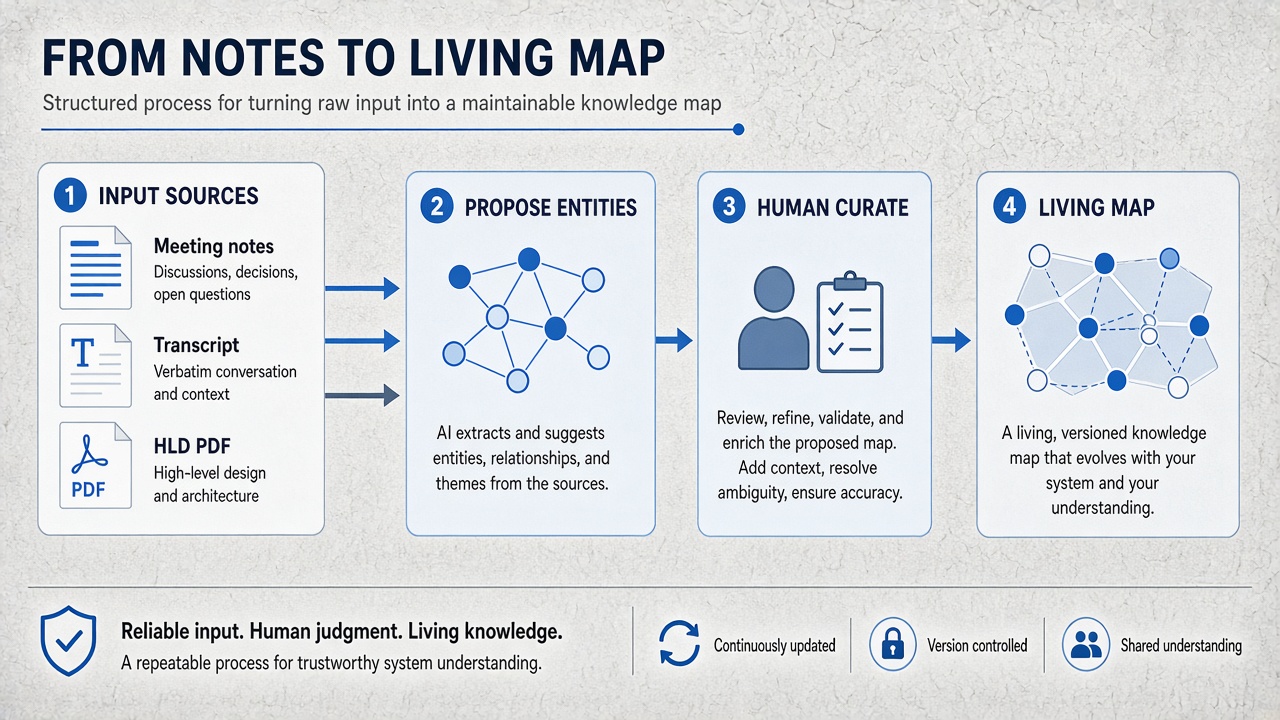
- Shape architecture context — metamodel + How/Why evidence + accountable curation.
- Automate discovery into that context — propose from documents and inventory, then curate (AI-accelerated discovery; LeanIX-aligned baselines).
- Make the map the default interface — Ask with citations; generate docs as views; give delivery agents context packs from the same record — not a new wiki crawl per run.
- Write back — accepted design updates return to the living map so the continuum compounds (IT Knowledge Continuum).
How does DecisionPen reduce the Context Tax?
DecisionPen is the Architecture Decision Workspace that holds the architecture context plane:
- Incremental discovery and human curation into a living map.
- Enterprise Ask instead of re-interviewing the estate.
- Artefacts generated as views of shared context.
- A Context of Record agents and programmes can consume — so rediscovery becomes extension, not restart.
Trial DecisionPen on one contested blast-radius question: compare a cited map answer to three squads’ private chatbots — that is the Context Tax made visible.
When is DecisionPen not the right tool?
If you only need a writing Copilot, a pure ops CMDB, or freeform Visio / Lucid / BPMN drawing. DecisionPen cuts Context Tax by owning curated landscape context — not by replacing diagramming canvases.