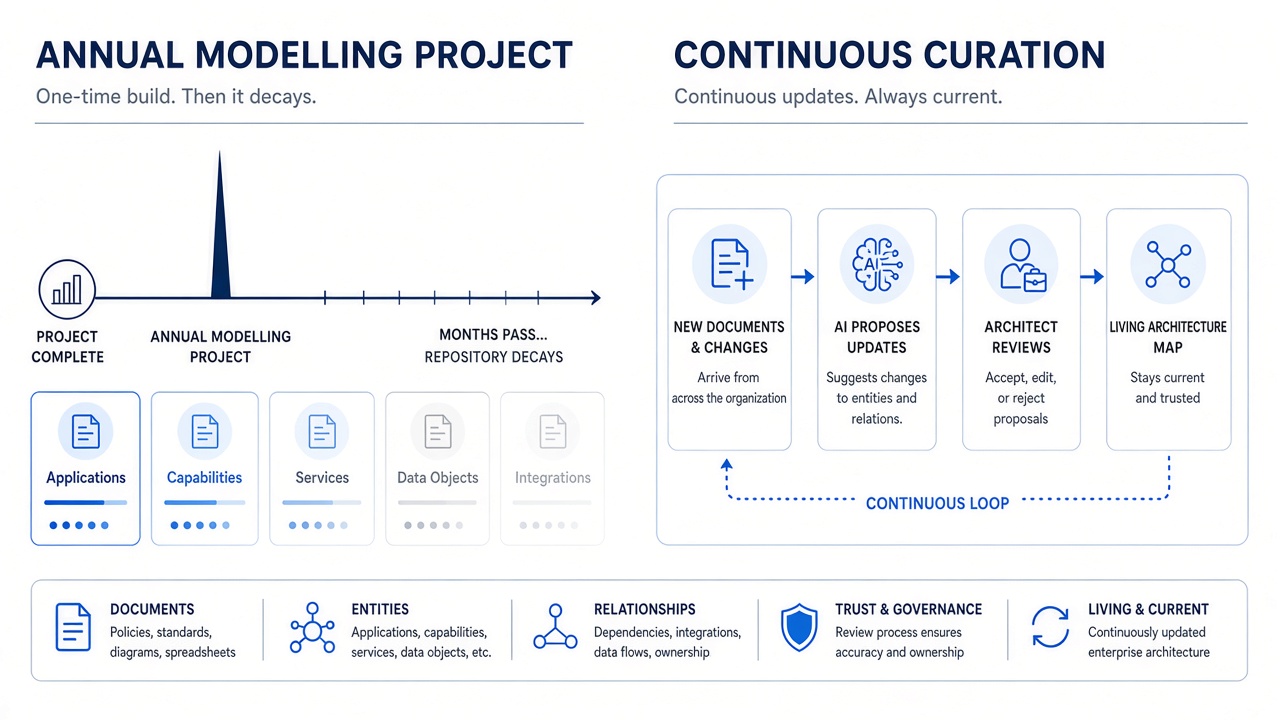
Most enterprise architecture repositories are built well once and then left to decay. A modelling project produces a respectable baseline; twelve months later the estate has moved on and the repository has not. This post sets out how to replace that cycle with continuous refresh: AI does the proposing, people do the curating, and the map stays close enough to reality to be used.
Why do enterprise architecture repositories go stale?
The cause is economic, not a lack of discipline. Keeping a repository current means re-reading documents, re-typing fields, and re-checking relationships — work that pays back late and rarely benefits the person doing it. So it is deferred, then batched into an annual project, then distrusted in between. The pattern is described in why architects hate manual EA modelling.
There is a second cost. A stale repository forces the next team to rediscover the landscape from scratch — the Discovery Tax paid again, programme after programme. Annual refresh does not remove that tax; it only schedules it.
What is the difference between an annual project and continuous refresh?
- Annual project — a large, expensive push by a small team; high accuracy on day one, steady decay afterwards; refresh competes with delivery work for attention.
- Continuous refresh — many small updates tied to real events; accuracy is maintained rather than restored; each update is cheap because AI has already drafted it.
The trade is not “less rigour”. It is the same rigour applied in smaller pieces, closer to the moment the evidence appears. That is what incremental modelling means in practice.
What does AI propose, and what do humans decide?
The division of labour is deliberate. AI is good at reading a lot of material quickly and drafting candidates; it is not accountable for what becomes authority.
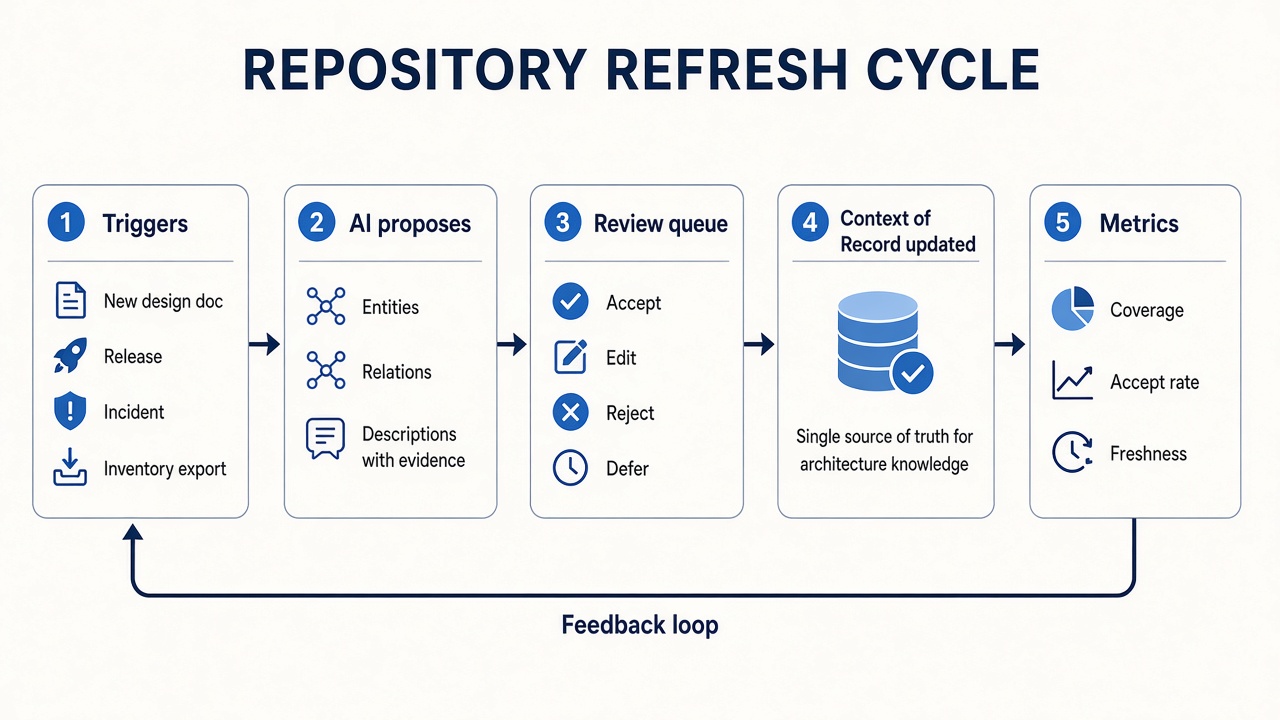
- AI proposes — new entities, typed relationships, updated descriptions, and flagged contradictions, each with the evidence behind it.
- Humans curate — accept, edit, reject, or defer. Rejections are remembered so the same suggestion does not return.
- The map records the outcome — accepted changes join the Context of Record with provenance, so every statement can be traced.
The review step is where trust is earned; it is covered in detail in how humans should review and curate AI-proposed models. For per-entity upkeep, see keeping factsheets current with AI descriptions and relation recommendations.
What triggers a refresh?
Tie refresh to events the organisation already produces, rather than to the calendar:
- A new or revised design document or architecture decision.
- A release, migration, or decommissioning decision.
- An incident review that exposes an undocumented dependency.
- A refreshed spreadsheet export from an inventory or CMDB.
- A new programme that needs a bounded slice of the landscape.
Each trigger adds evidence; the AI proposes what that evidence changes; a steward decides. Nothing needs a separate “modelling project”.
How do you run the review queue without it becoming a chore?
- Prioritise — surface proposals that touch high-impact or high-traffic entities first.
- Time-box — a regular, short slot (for example weekly) beats an annual marathon.
- Review claims, not fields — spend time on relationships and contradictions, not on every attribute.
- Give use a role — the most reliable motivation is that the map is needed for real work. See the incremental modelling flywheel.
How do you know the repository is current?
Measure freshness directly instead of relying on confidence:
- Description and relationship coverage for in-scope entities.
- Age of the evidence behind your most-used entities.
- Accepted-versus-rejected rate of proposals, by source.
- Review-queue age and the number of unresolved contradictions.
- Questions the map could not answer when asked.
Trends matter more than a single score. A falling accept rate or a growing queue is an early warning, long before users stop trusting the map.
How does DecisionPen solve this?
DecisionPen is an Architecture Decision Workspace built for continuous refresh rather than periodic rebuilds.
- Incremental modelling — new documents and spreadsheets extend the existing map instead of restarting it.
- AI proposals with evidence — entities, relationships, descriptions, and contradictions arrive as reviewable drafts.
- Human curation — accept, edit, reject, or defer; nothing becomes authority without review.
- Living map — accepted updates immediately improve Enterprise Ask and generated ADRs, blueprints, and diagrams, so upkeep pays back at once.
Trial DecisionPen by loading one recent document set into an existing domain and measuring how many proposals are accepted in a single review session.
When is DecisionPen not the right tool?
If you expect fully unattended, auto-published updates with no accountable steward, live infrastructure scanning, or a CMDB sync, this is the wrong approach. DecisionPen proposes from the documents and spreadsheets you give it, for human curation. It is not an autonomous scanner and does not remove the need for ownership.
What to read next
- How should humans review and curate AI-proposed architecture models?
- How do you keep EA factsheets current with AI?
- What is the Discovery Tax in IT transformations?
- How does incremental modelling create an architecture knowledge flywheel?
- Incremental modelling
Series index (Conversion how-tos)
- D8a — Fast-track M&A IT due diligence
- D8b — Build application dependency maps from documentation
- D8c — Assess a landscape without months of workshops
- D8d — This post (keep the repository up to date with AI)
- D8e — The incremental modelling flywheel