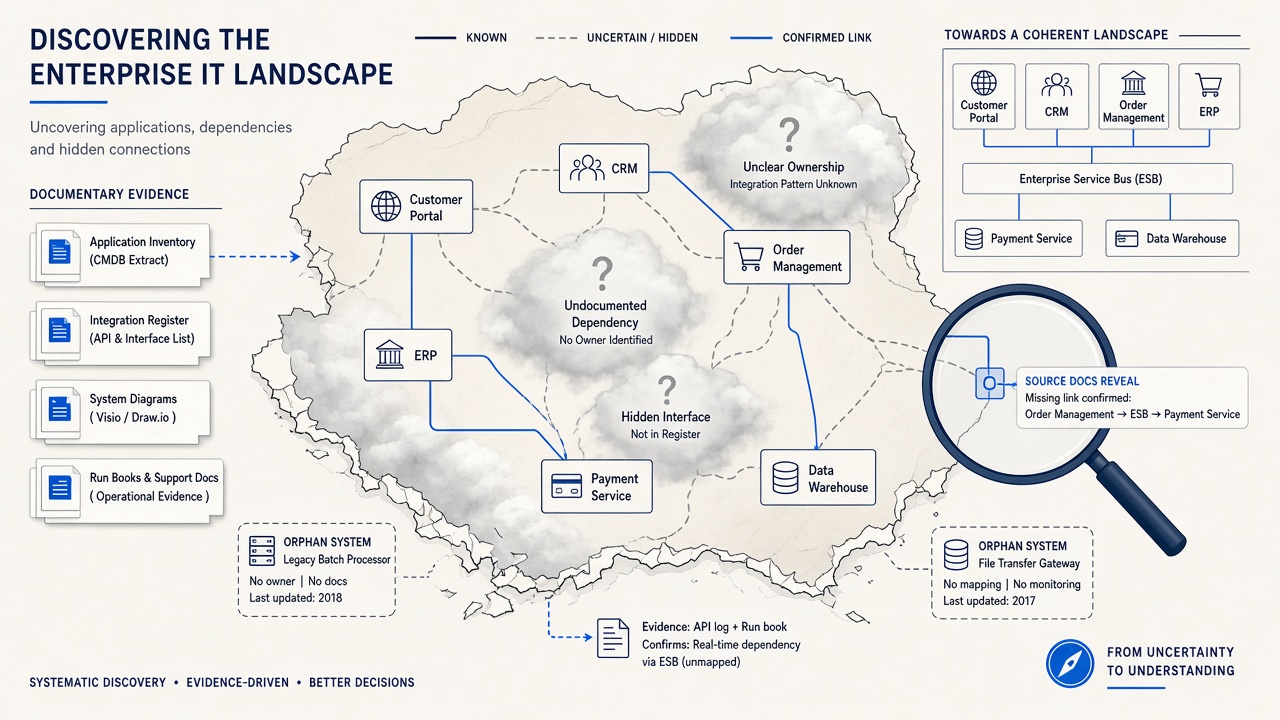
You assess an IT landscape without months of workshops by building the first draft from evidence you already hold and reserving workshops for decisions, contradictions, and gaps — not for reciting an inventory. Documents and spreadsheets produce a proposed map; people correct and judge it. The workshop becomes a review of something concrete instead of a blank factsheet to be filled in live.
Why do landscape assessments turn into months of workshops?
The usual pattern is well meant. A programme needs to understand the estate, so the architecture team schedules sessions with each domain, asks everyone to describe their applications, and captures the answers in a repository template. Weeks pass. People repeat what is already in their own design documents. The captured detail is uneven, and the record starts ageing as soon as the last session ends.
That cost is the Discovery Tax, and it is largely paid in the wrong currency: scarce expert time spent on inventory rather than judgement. It also reinforces the dependency on individuals described in why enterprise architecture runs on tribal knowledge.
What is blank-factsheet theatre?
Blank-factsheet theatre is the workshop in which a facilitator opens an empty record — name, owner, lifecycle, technology — and asks the room to dictate the contents. It looks like progress because fields get filled, but the information is often available elsewhere, the answers depend on who happens to attend, and the How and Why rarely make it into the template (see why factsheets miss the How and Why).
How can you assess a landscape from evidence first?
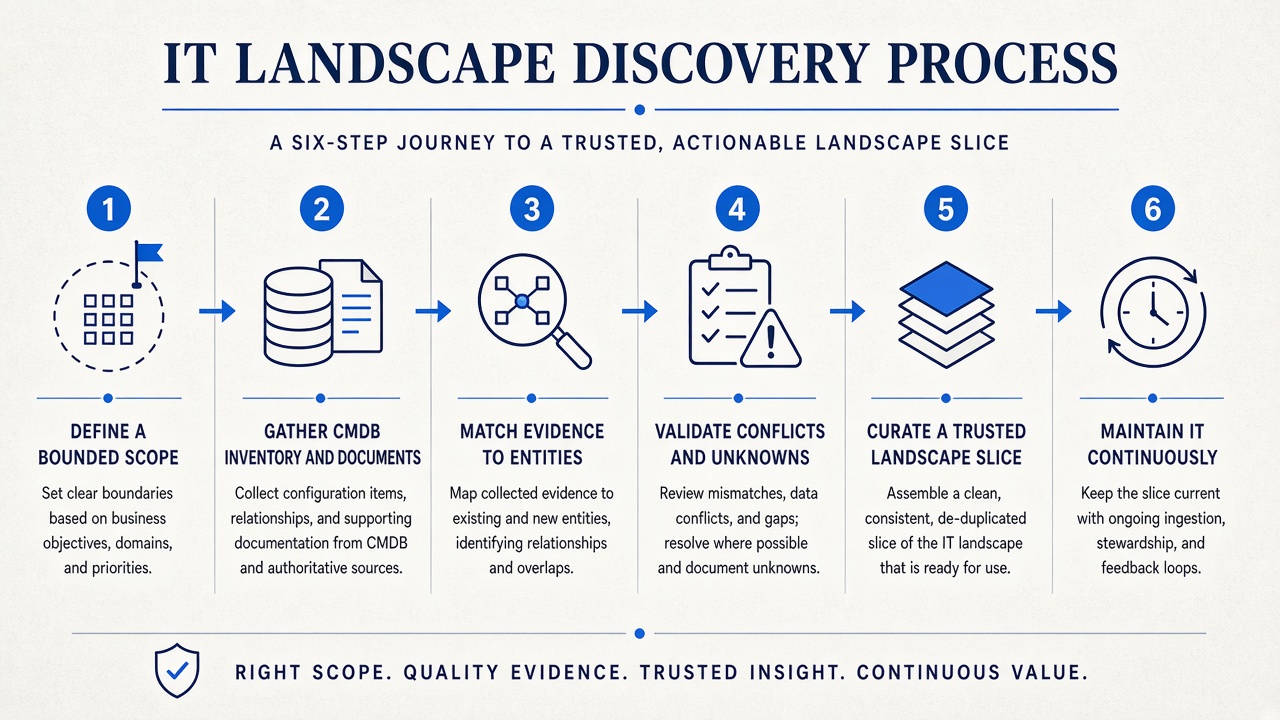
- Bound the scope. Choose a domain, platform, or transformation boundary and the decisions the assessment must support. “The whole enterprise” is not a scope.
- Collect what exists. Architecture documents, solution designs, application and technology inventories, integration registers, vendor and hosting lists. A CMDB extract can join them as a spreadsheet import.
- Model automatically. Let the documents and spreadsheets produce proposed entities, relationships, and descriptions under your metamodel.
- Triage the draft. Sort the proposals into confident, conflicting, and missing. Curate the confident ones quickly.
- Run short, targeted workshops. Bring the conflicts and gaps for each domain to the people who can settle them.
- Assess against the map. Ask the decision questions — overlap, risk, end-of-life exposure, dependency — and record the answers with their evidence.
The step-by-step version of this approach, including scope and evidence selection, is in the IT landscape discovery guide.
What should workshops cover once the draft exists?
- Contradictions — two sources describe the same integration differently; which is right?
- Gaps — an application with no owner, no interfaces, or no lifecycle status.
- Intent — what the owner plans to retire, replace, or invest in; this is rarely written anywhere.
- Risk and constraints — contractual, regulatory, or operational limits that documents imply but do not state.
- Prioritisation — which findings matter for the decision on the table.
Sessions shift from “tell us about your system” to “is this right, and what should we do about it?” They are shorter, better attended by the right people, and produce corrections that feed straight back into the map.
How do you keep the assessment from going stale?
An assessment that ends as a slide deck begins decaying immediately. Keep the curated map as the working record: new documents extend it, later decisions write back to it, and the next assessment starts from the current state rather than from zero. This is the difference between a point-in-time baseline and a living one, explored in from automated discovery to durable architecture context. It also means changes can be reviewed incrementally using the approach in reviewing and curating AI-proposed models.
How does DecisionPen solve this?
DecisionPen is an Architecture Decision Workspace that produces the first draft of the landscape from your documents and spreadsheets, so human time goes to review and decisions.
- Documents in, draft map out through incremental modelling, with evidence attached to every proposal.
- Spreadsheet imports for application inventories and CMDB extracts, alongside unstructured documents.
- Curation queues that surface conflicts and gaps for short, targeted sessions.
- Ask the landscape with Enterprise Ask, answers cited to the source.
- Artefacts from context — assessment summaries and diagrams generated from the curated model rather than drawn separately.
Trial DecisionPen on the next assessment you would otherwise run as a workshop series: load the existing documents first, then compare the draft with what the workshops would have captured.
When is DecisionPen not the right tool?
If little or nothing is written down, there is no evidence to model from, and workshops are the only source; DecisionPen will help you capture and structure that knowledge but cannot conjure it. It does not replace stakeholder conversations about intent and risk, it does not sync live with a CMDB (spreadsheet import only), it does not scan infrastructure, and it is not a Visio-style drawing tool.
What to read next
- IT landscape discovery guide
- What is the Discovery Tax in IT transformations?
- How to start EA from documents in 30 days
- How do you build application dependency maps from documentation?
Series index (Conversion how-tos)
- D8a — Fast-track M&A IT due diligence
- D8b — Build application dependency maps from documentation
- D8c — This post (assess a landscape without months of workshops)
- D8d — Keep the repository up to date with AI curation
- D8e — The incremental modelling flywheel