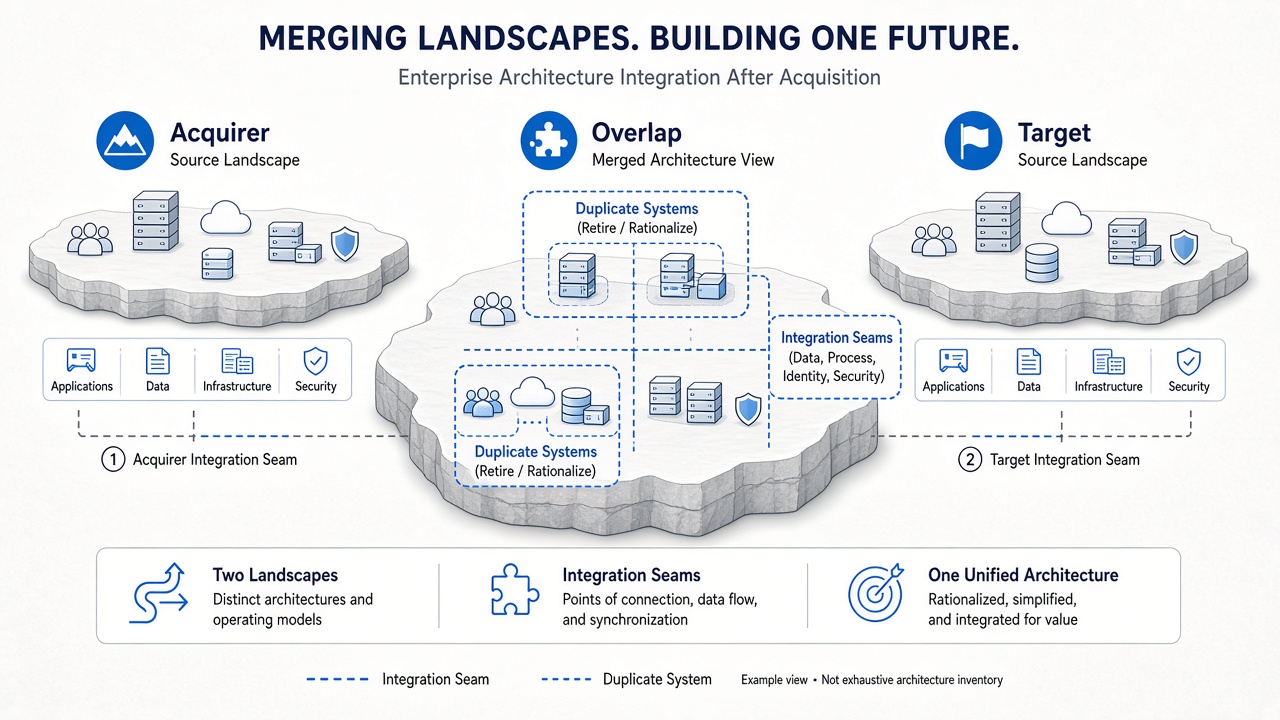
You fast-track M&A IT due diligence by putting the documents in and getting a curated map out: ingest what the data room already holds, let automated landscape modelling propose applications, platforms, and integrations, review the high-impact slice, and then ask diligence questions against that map. You trade weeks of reading and briefings for days of curation — without pretending the output is finished truth.
Why is IT due diligence so hard under time pressure?
Deal timetables are fixed by the transaction, not by how long it takes to understand a target’s estate. The evidence arrives late and in pieces: a partial data room, a spreadsheet of applications, a handful of architecture decks, and a few people who “know how it really works.” Meanwhile the questions are specific — which systems overlap, what breaks if we separate, what does integration cost — and the answers shape price and synergy assumptions.
The result is the Discovery Tax paid in its harshest form: reading everything once, briefing the deal team, and then losing the work when the data room closes. If you want the wider view of what an EA tool should do around mergers, see enterprise architecture tools for M&A; this post is the practical playbook for the diligence window itself.
What does “documents in, map out” mean?
It means the starting point is the material you already have, and the deliverable is a navigable model rather than a stack of summaries. Automated landscape modelling reads architecture documents, solution designs, inventories, and notes, and proposes typed entities and relationships under a metamodel. You then curate the proposals into a trusted slice. The pattern is described in more depth in automated IT landscape modelling from unstructured data.
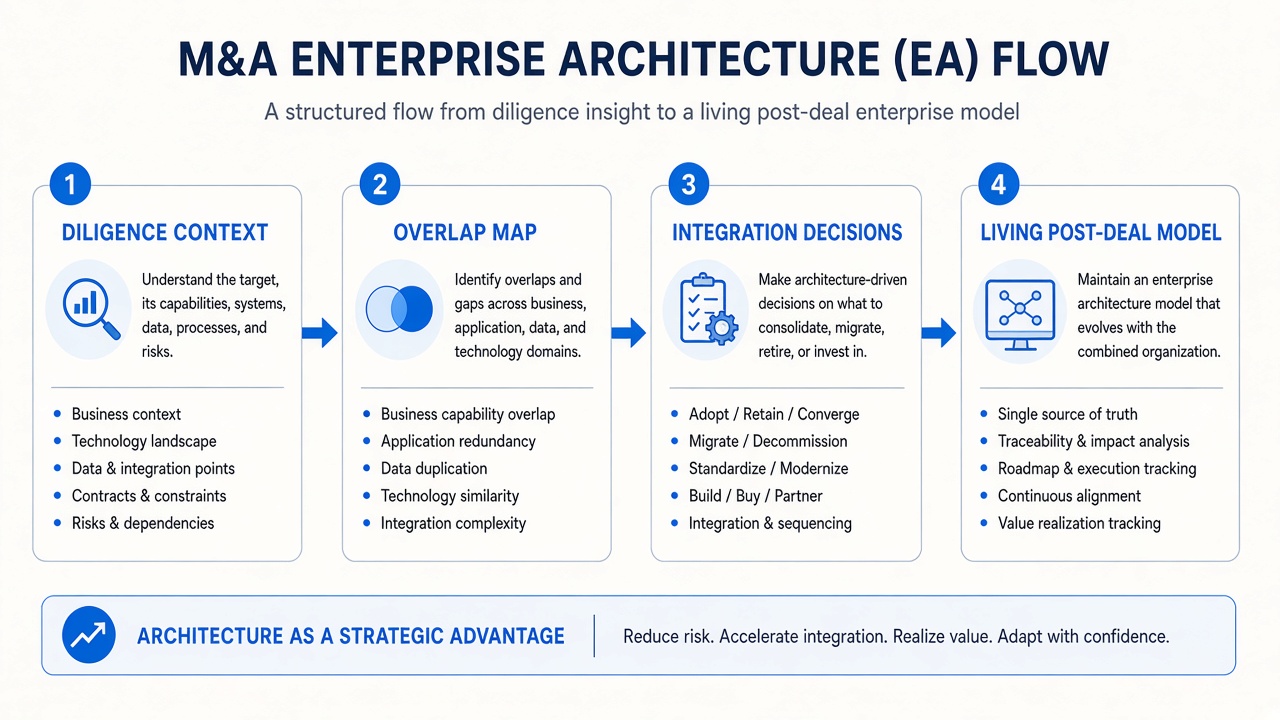
What is a practical playbook for the diligence window?
- Fix the questions first. List the ten to fifteen decisions the deal team must make: overlap by domain, critical platforms and end-of-life exposure, integration seams, separation dependencies, shared services, regulatory constraints. Scope follows the questions, not the other way round.
- Ingest in priority order. Start with architecture decks, high-level designs, application inventories, and integration registers from the target. If the acquirer’s own landscape is thinly documented, ingest that too — overlap needs both sides.
- Let the model propose. Applications, platforms, vendors, capabilities, and the interfaces between them are proposed with links back to the passage or row that suggested them.
- Curate the high-impact slice. Review the entities that touch your questions first. Accept, merge duplicates, correct types, and mark gaps. Leave the long tail for later.
- Ask against the map. Use cited answers for overlap, dependency, and blast-radius questions, and record where the evidence runs out.
- Spend human time where the data room is silent. Target management sessions then become focused on contradictions and unknowns, not on reciting what is already written down.
How do you handle structured and unstructured evidence together?
Most targets provide both a spreadsheet and a pile of documents, and they rarely agree. Treat the spreadsheet — including a CMDB export — as one source among several, imported as a file rather than synchronised live. It supplies names and identifiers; the documents supply purpose, integration detail, and constraints. Conflicts between them are findings worth raising, not noise to be smoothed away. The wider method is covered in modelling from structured and unstructured sources with AI.
What should the deal team be able to answer by the end?
- Which applications and platforms overlap, and by how much?
- What are the critical integration seams between the two estates?
- Which systems are near end of life or single-vendor dependent?
- What would be hard to separate or carve out, and why?
- Where is the evidence thin — and who should be asked?
Because every answer cites its sources, the deal team can defend a number in the investment case or challenge a vendor claim in the room.
What happens after signing?
The diligence model should not be archived with the deal room. The same curated map becomes the starting point for integration planning, with decisions recorded against the entities they affect. That continuity removes a second discovery exercise at Day 1 and keeps the rationale behind the deal assumptions attached to the landscape. See how to start EA from documents in 30 days for the same approach without a deal clock.
How does DecisionPen solve this?
DecisionPen is an Architecture Decision Workspace built for exactly this compression: documents and spreadsheets in, a curated, askable landscape out.
- Automated landscape modelling proposes entities and relationships from the data-room material through incremental modelling.
- Evidence kept attached — each proposed entity and edge points back to its source passage or row.
- Human curation keeps the model honest; nothing becomes authority without review.
- Ask with citations through Enterprise Ask for overlap and dependency questions.
- Diagrams from context — overlap and integration views are generated from the curated model rather than drawn by hand.
Trial DecisionPen on a recent deal or a hypothetical one: load a target’s decks and inventory, and see how much of the overlap picture you can curate in a few days.
When is DecisionPen not the right tool?
If the data room is effectively empty, there is nothing to model from — you need interviews and access first. DecisionPen is not a scanner of the target’s live infrastructure, it does not sync with a CMDB (a spreadsheet import is the supported route), and it is not a Visio-style drawing tool. It will not replace commercial, legal, or security diligence; it speeds up the architecture understanding those workstreams depend on.
What to read next
- Enterprise architecture tools for mergers and acquisitions
- Automated IT landscape modelling from unstructured data
- What is the Discovery Tax in IT transformations?
- How should humans review and curate AI-proposed models?
- How do you keep EA factsheets current with AI?