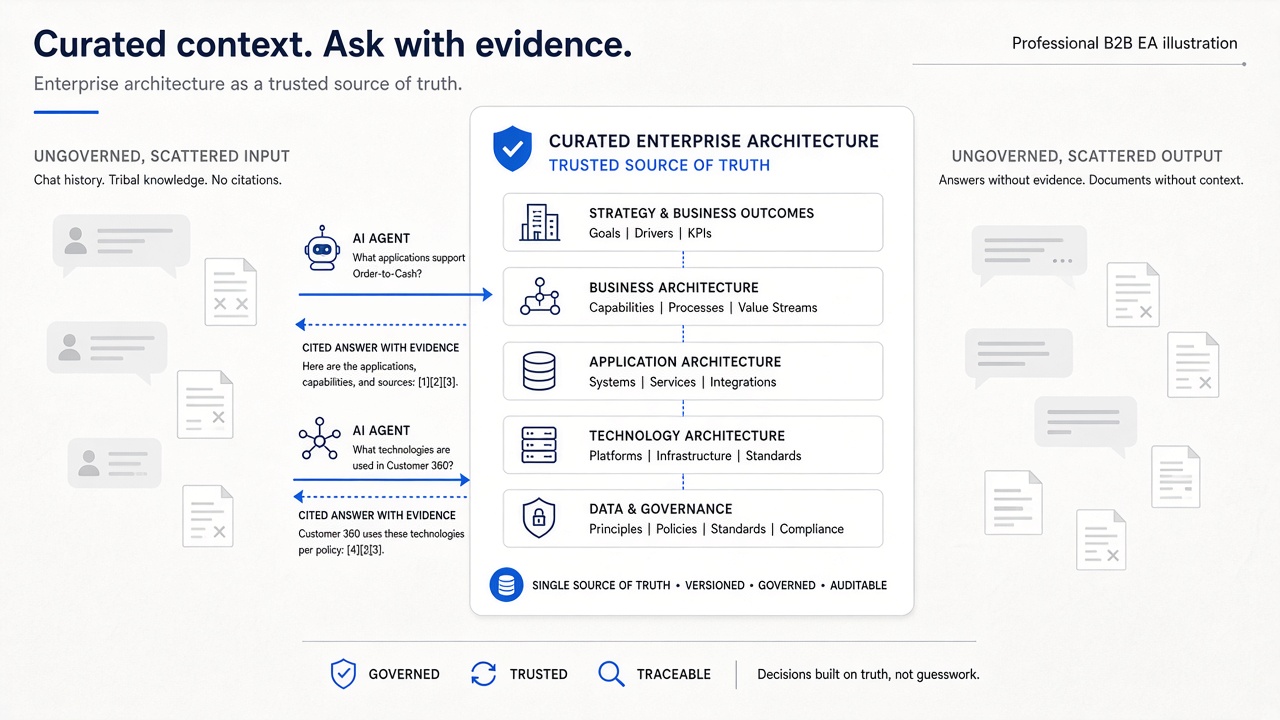
Shaping enterprise context for IT knowledge management means building a curated, metamodel-aware map of the estate with How/Why evidence, clear ownership, and an askable interface — not stocking another wiki. Search intent clusters around IT KM beyond Confluence, architecture knowledge management, and enterprise context for IT knowledge management.
IT KM’s context problem
Classic IT knowledge management optimises for findability of documents. That helps reading; it does not create a single landscape authority. When every team “knows” the estate from a different SharePoint folder, you pay the Context Tax — and tribal memory remains the real system of record (why EA still runs on tribal knowledge).
What “shaping” means
Shaping is deliberate design of enterprise architecture context, not a larger context window:
- Structure — entities and relationships in a metamodel (applications, capabilities, technology, integrations).
- Bind — attach source evidence so claims stay explainable (How/Why with the What).
- Own — name a steward of curation (usually EA), with contributors across SA and delivery.
- Ask — expose a map-grounded interface so knowledge is used, not only stored.
- Refresh — continuous discovery from new documents and inventory (AI-accelerated discovery), not a yearly baseline project.
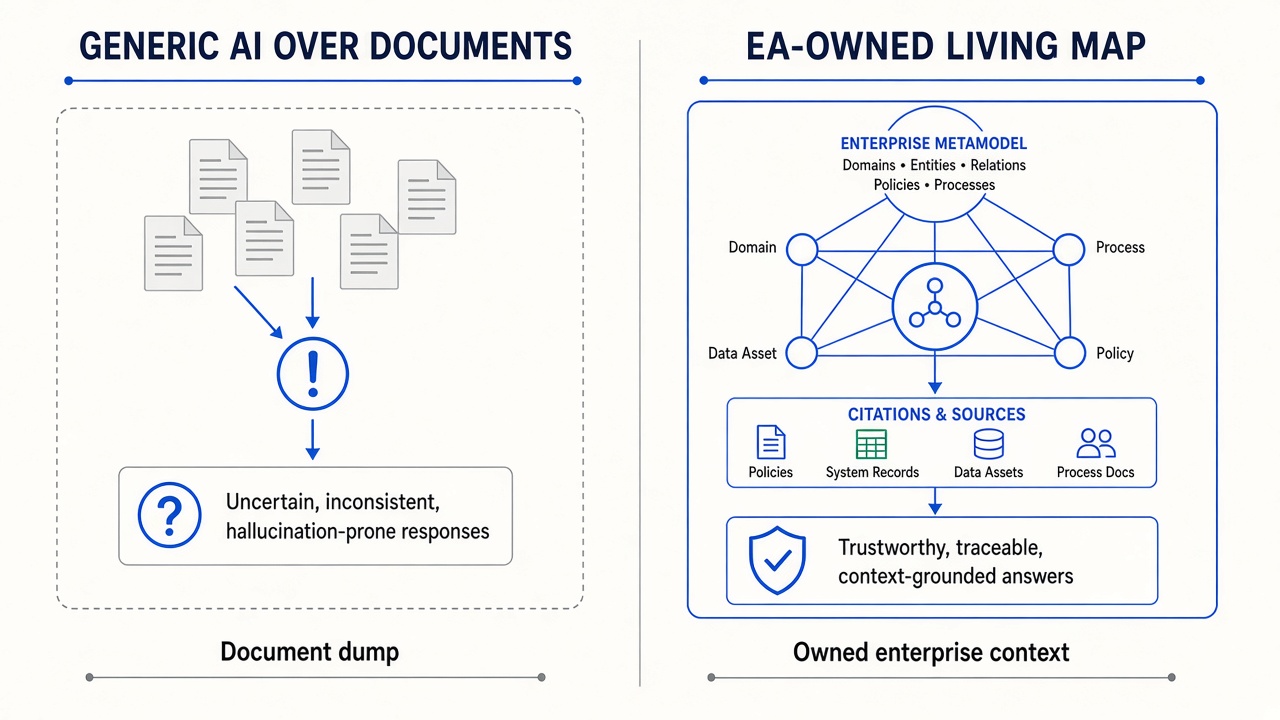
Five layers of shaped IT knowledge
- Inventory — what exists (often seeded from CMDB or catalogue extracts).
- Relationships — how things connect and realise capabilities.
- How/Why evidence — behaviour, rationale, constraints from HLDs, notes, and decisions.
- Decisions and standards — accepted commitments that constrain change.
- Askable interface — cited answers and generated views for programmes and agents (Enterprise Ask; docs as views of living context).
Skip a layer and knowledge management collapses back into search: plenty of hits, little shared truth. That is the continuum break described in the IT Knowledge Continuum.
A practical shaping sequence for IT KM leaders
- Pick a bounded domain where pain is acute (payments, CRM, shared platforms).
- Import inventory and ingest the document pack that already exists.
- Propose → curate a trusted slice (incremental modelling).
- Publish Ask access for architects and programme leads; retire “email Dave” as the default path for that slice.
- Instrument refresh: new HLDs and change records update the map; accepted designs write back.
How does DecisionPen shape context for IT KM?
DecisionPen is an Architecture Decision Workspace purpose-built for shaped enterprise context:
- Metamodel-aware living map with LeanIX-aligned modelling when needed.
- Evidence bound to entities from documents and dialogue.
- Human curation as the ratification step.
- Enterprise Ask and generated artefacts so IT knowledge is consumed as a Context of Record — reducing Context Tax.
Trial DecisionPen on one knowledge-hot domain: measure whether blast-radius and ownership questions stop bouncing between wiki search and key people.
When is DecisionPen not the right tool?
If you only need intranet publishing, a general search Copilot, or freeform Visio / Lucid / BPMN drawing. DecisionPen shapes architecture context for decisions — it is not a CMS or drawing canvas.