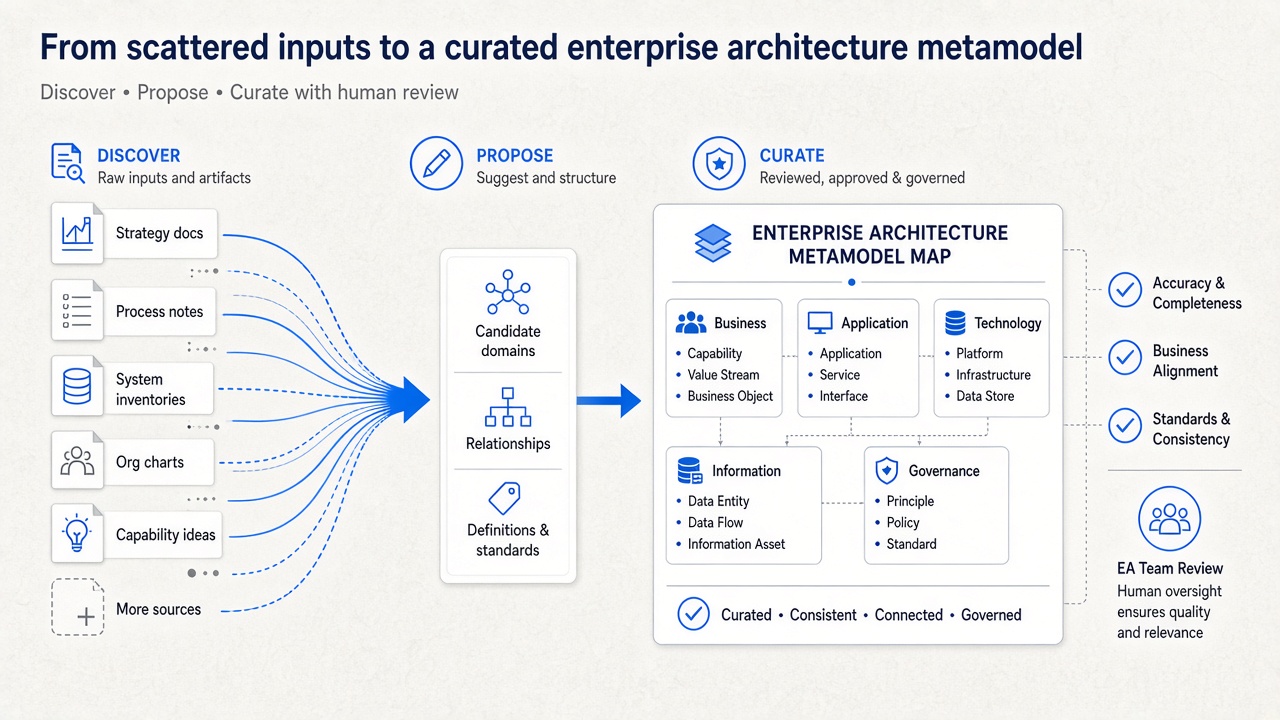
Evidence-Linked Discovery is a working method that turns automated enterprise discovery into durable architecture context: AI proposes metamodel-aware landscape updates from documents and inventory; humans curate; the organisation asks and generates from a Context of Record; delivery agents consume context packs and write accepted design back. Discovery stops being a one-off baseline PDF. Search intent clusters around discovery to Context of Record, durable enterprise architecture context, and Evidence-Linked Discovery.
Problem statement
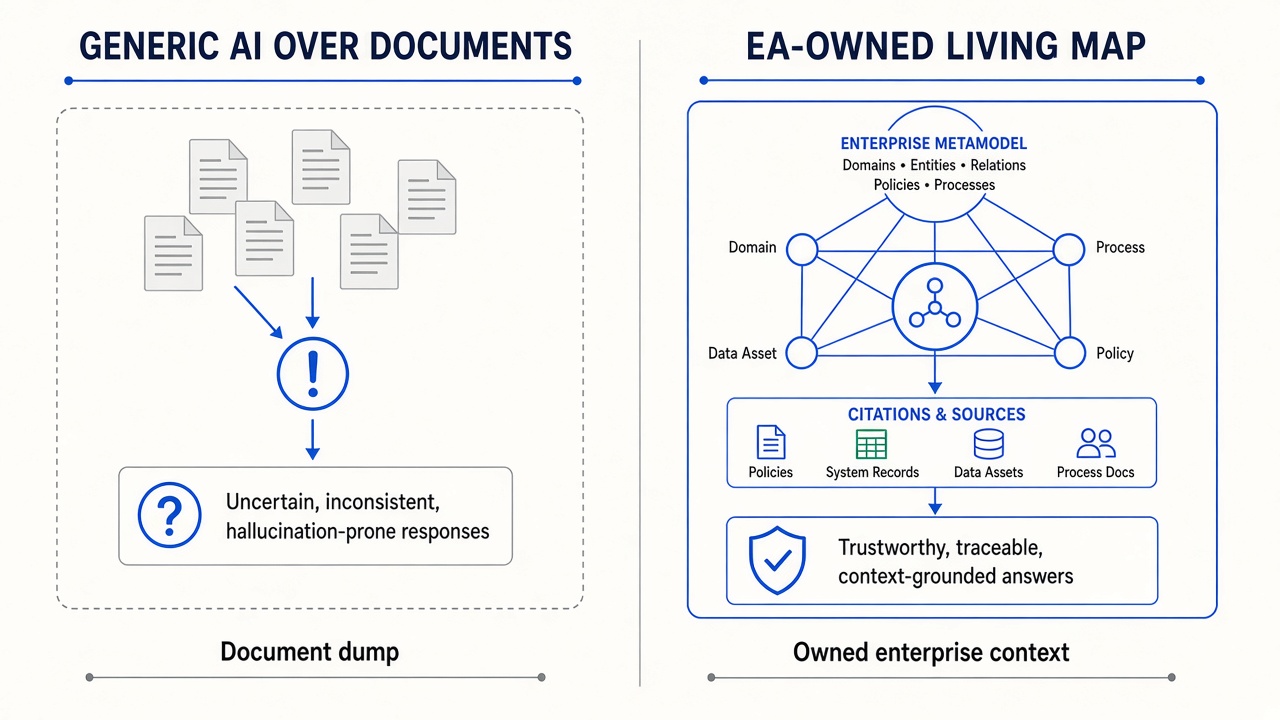
Enterprises pay the Discovery Tax to build as-is baselines, then the Context Tax when humans and agents re-assemble landscape truth anyway. Inventory connectors and wiki RAG each solve a fragment. What is missing is a closed loop from automated discovery to a living architecture context plane that agentic delivery can trust (architecture context for agentic SDLC).
The loop (seven steps)
- Bound — choose a domain or programme slice; refuse “whole enterprise” as the first milestone.
- Ingest — CMDB/inventory extract and/or HLDs, wikis, notes for that scope (AI-accelerated discovery).
- Propose — metamodel-aware entities and relationships (LeanIX-aligned when that is the language — LeanIX-compliant baseline).
- Bind evidence — How/Why passages stay attached to candidates so curation is explainable.
- Curate — accept, merge, reject, mark unknowns (incremental modelling).
- Ask & publish — Enterprise Ask; generate artefacts as views of context; shape IT KM around the map (shaping context for IT KM; architecture KM vs document KB).
- Consume & write back — issue context packs to delivery agents; write accepted design outcomes into the living map (IT Knowledge Continuum).
Evaluation criteria (method health)
- Time-to-first-trusted-slice — days for a bounded domain, not a quarter of blank factsheets.
- Curation rate — proposals reviewed vs unsupervised dump size.
- Evidence coverage — share of entities with bound How/Why sources.
- Ask citation usage — answers grounded in map + evidence, not vibes.
- Context Tax symptoms — fewer conflicting squad/agent landscape answers for the same question.
- Write-back — accepted designs return to the Context of Record instead of dying in private HLDs.
What the method is not
- A one-shot LeanIX population project with no reuse loop.
- Ungoverned “AI fills the repo” without human ratification.
- A coding Copilot or CI/CD platform — those are delivery planes; this method owns the architecture context plane.
- A substitute for document stores — wikis remain evidence; they are not the landscape authority.
How DecisionPen implements the method
DecisionPen is an Architecture Decision Workspace built for Evidence-Linked Discovery end-to-end: ingest, propose, curate, Ask, artefacts, and a living map that grounds humans and agentic delivery — reducing Discovery Tax and Context Tax together (beyond traditional EA).
Trial DecisionPen on one domain: run the seven steps once, then measure the evaluation criteria against your last manual baseline cycle.
When is DecisionPen not the right tool?
If you only need network scanning, a CMS, a coding Copilot, or freeform Visio / Lucid / BPMN drawing. Evidence-Linked Discovery assumes you need durable architecture context — DecisionPen is the workspace for that job.